
When Chicago businesses retire computers, servers, or storage devices, the data stored on hard drives remains a critical liability until properly destroyed. Simply deleting files or reformatting drives leaves recoverable data that can expose sensitive customer information, financial records, or proprietary business data. Proper hard drive destruction goes beyond software-based methods to ensure that information is physically rendered unrecoverable.
1. Why Physical Destruction Matters More Than Data Wiping
Software-based data wiping overwrites hard drive sectors with random data patterns, making recovery difficult under normal circumstances. However, wiping alone leaves the physical drive intact and potentially vulnerable to advanced forensic recovery techniques. Drives that are wiped but not destroyed can be resold, lost in transit, or mishandled, creating ongoing data security risks.
Physical destruction eliminates this vulnerability by rendering the storage media itself inoperable. Methods such as crushing, shredding, or punching create permanent physical damage to the platters, controller boards, and read-write heads. Once a hard drive has been mechanically destroyed, no software tool or data recovery service can reconstruct the information. For organizations handling protected health information, financial data, or personally identifiable information, physical destruction provides a final layer of assurance that data cannot be retrieved.
Many compliance frameworks recognize the superiority of physical destruction for end-of-life media. The NIST SP 800-88 guidelines, which provide federal standards for media sanitization, classify physical destruction as the most secure method for ensuring data is unrecoverable. Organizations subject to HIPAA, GLBA, FACTA, and other regulations often require physical destruction to satisfy their obligations for secure data disposal.
2. The On-Site Crusher at Our Addison, Illinois Facility
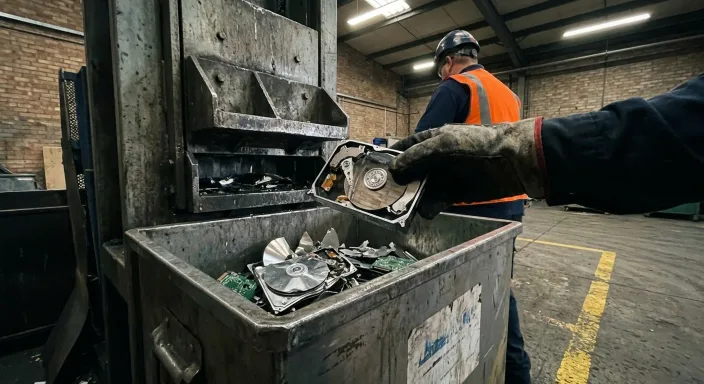
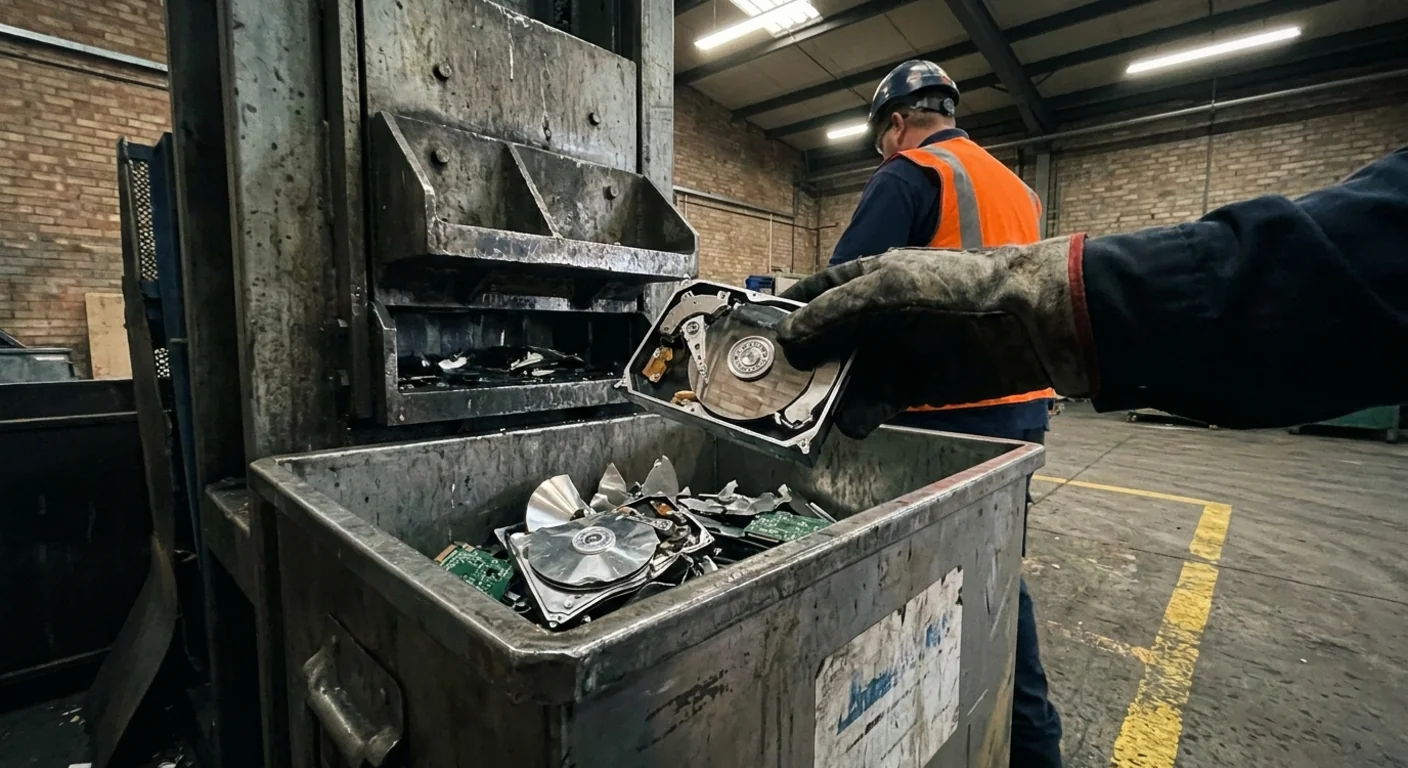
Chicago Shredder operates an on-site hard drive crusher at our Addison, Illinois facility, providing Chicago-area businesses with local access to secure physical destruction services. The crusher applies thousands of pounds of force to each hard drive, bending and breaking the internal platters, circuit boards, and mechanical components beyond any possibility of data recovery. This process takes seconds per drive and ensures that no readable data remains on the device.
On-site destruction means your hard drives never leave our secure facility for processing at a distant location. Drives are transported directly from your Chicago office or data center to our Addison location, where they are logged, inventoried, and destroyed under controlled conditions. This reduces the time your decommissioned drives spend in transit and minimizes the risk of loss or theft during transportation.
The crusher accommodates all standard hard drive form factors, including 2.5-inch laptop drives, 3.5-inch desktop and server drives, and legacy formats. Solid-state drives, which store data on flash memory chips rather than magnetic platters, are also physically destroyed using the same equipment.
3. Shredding, Punching, and Crushing Methods Compared
Physical hard drive destruction takes several forms, each with distinct operational characteristics. Crushing applies hydraulic or pneumatic force to deform the entire drive assembly, breaking platters and circuit boards simultaneously. Punching uses a penetrating tool to pierce the drive casing and platters at multiple points, creating holes that disrupt data storage surfaces. Shredding feeds drives through industrial cutting blades that reduce the devices to small fragments, typically one inch or smaller.
Crushing offers speed and efficiency for high-volume operations, processing individual drives in seconds without requiring disassembly. The method is effective for both magnetic and solid-state storage media. Punching provides a visible, auditable result with clear penetration points, though it may be slower for large batches. Shredding delivers the highest level of physical destruction, rendering drives completely unrecognizable, but requires more processing time and specialized equipment.
Chicago Shredder's on-site crusher balances throughput, security, and cost-effectiveness for Chicago businesses. The method aligns with the DoD 5220.22-M standard for physical destruction and meets the physical destruction criteria outlined in the NIST SP 800-88 guidelines.
4. Alignment with DoD 5220.22-M Standard and NIST SP 800-88 Guidelines
The DoD 5220.22-M standard has historically provided specifications for data sanitization, including both software-based overwriting and physical destruction methods. While the standard itself has been superseded by NIST guidelines in federal contexts, the term remains widely recognized in commercial data security discussions. Physical destruction methods that render storage media permanently inoperable satisfy the standard's requirements for ensuring data is designed to be unrecoverable.
The NIST SP 800-88 guidelines represent the current federal framework for media sanitization. These guidelines classify sanitization into three categories: Clear, Purge, and Destroy. Physical destruction falls under the Destroy category, which NIST defines as rendering media unable to be used for storage through disintegration, pulverization, melting, or incineration. Crushing and shredding both qualify as Destroy-level methods when performed to specifications that prevent data recovery.
Chicago Shredder's destruction processes are designed to align with these nationally recognized guidelines. Our crushing equipment meets the physical destruction requirements that federal agencies, financial institutions, healthcare providers, and other regulated entities rely on to satisfy their data sanitization obligations.
5. Certificate of Destruction and Chain of Custody Documentation
After hard drives are destroyed at our Addison facility, Chicago Shredder provides a Certificate of Destruction that documents the service, inventory, and destruction method. This certificate serves as auditable proof that your organization took appropriate steps to protect sensitive data at end-of-life.
Chain of custody documentation tracks each hard drive from the moment it leaves your facility until destruction is complete. This includes pickup logs, transportation records, facility intake documentation, and destruction confirmation. Maintaining an unbroken chain of custody is critical for regulatory audits, legal discovery, and internal compliance reviews. It demonstrates that your organization maintained control over sensitive media throughout the disposal process and that no unauthorized access occurred.
For Chicago businesses subject to strict compliance requirements, these documents provide the evidence needed to demonstrate due diligence. HIPAA-covered entities must show that electronic protected health information was destroyed in accordance with the Security Rule. Financial institutions under GLBA must document proper disposal of customer information. Companies handling credit card data must satisfy PCI-DSS requirements for secure media destruction. Chicago Shredder's documentation packages are designed to support compliance requirements across these and other regulatory frameworks.
6. Supporting HIPAA, GLBA, and FACTA Compliance Requirements
Healthcare organizations in the Chicago area face HIPAA Security Rule requirements that mandate appropriate disposal of electronic protected health information. The rule requires covered entities to implement policies and procedures for the final disposition of electronic PHI and the hardware that stores it. Physical destruction of hard drives containing patient records, billing information, or medical imaging data provides a defensible method for satisfying these obligations.
Hard drives from banking systems, loan processing servers, or payment terminals may contain account numbers, Social Security numbers, credit reports, or transaction histories. Physical destruction ensures this information cannot be reconstructed, reducing the risk of identity theft and regulatory penalties.
The Fair and Accurate Credit Transactions Act extends disposal requirements to any business that uses consumer reports or information derived from consumer reports. This includes employers conducting background checks, landlords reviewing credit histories, and retailers offering financing. When these organizations retire computers or storage systems, FACTA requires destruction or erasure of consumer information. Chicago Shredder's destruction services are designed to support compliance requirements under FACTA, providing the documentation and destruction methods needed to demonstrate proper disposal practices.
7. Why Local Chicago Businesses Choose Chicago Shredder
Chicago-area organizations value working with a local provider that understands the regional business environment and offers responsive, accessible service. Our Addison facility is centrally located for convenient access from Chicago's downtown Loop, suburban office parks in Schaumburg and Naperville, and industrial areas throughout Cook, DuPage, and Lake counties. Proximity reduces transportation time, lowers logistics costs, and allows for faster turnaround on destruction services.
This means that after destruction, metal, plastic, and electronic components are recovered and recycled rather than discarded, supporting your organization's sustainability goals while maintaining data security.
Businesses across healthcare, finance, legal, education, and professional services sectors rely on Chicago Shredder for secure hard drive destruction. Whether you are decommissioning a single server or clearing out an entire data center, our team typically responds within one business day to discuss your requirements, provide pricing, and schedule service.
8. Frequently Asked Questions
Is data wiping enough, or do I need physical destruction?
Data wiping can be effective for drives that will be reused, but physical destruction provides the highest level of security for end-of-life devices. Wiping leaves the drive intact, which can create risks if the drive is lost, stolen, or improperly resold. Physical destruction ensures data is designed to be unrecoverable by rendering the storage media itself permanently inoperable.
What happens to hard drives after they are crushed?
Metal, plastic, and electronic components are separated and recycled according to secure, transparent recycling practices, ensuring no materials are knowingly disposed of in landfills.
Do you provide certificates of destruction for compliance audits?
Yes, Chicago Shredder provides a Certificate of Destruction for every service, documenting the date, quantity, and method of destruction. This certificate, along with chain of custody documentation, serves as auditable proof that your organization properly disposed of sensitive data in alignment with regulatory requirements.
Can you destroy solid-state drives and other storage media?
Our on-site crusher at the Addison facility can physically destroy solid-state drives, traditional hard drives, backup tapes, and other storage media. SSDs require physical destruction rather than wiping due to wear-leveling technology that can leave data remnants, making crushing or shredding the preferred method for these devices.
How quickly can you schedule a pickup in the Chicago area?
Chicago Shredder typically responds within one business day to schedule pickups throughout the Chicago metropolitan area. Turnaround depends on volume, location, and scheduling availability, but we work to accommodate urgent requests and provide flexible service options for both one-time projects and ongoing programs.
Does physical destruction meet HIPAA and GLBA requirements?
Physical destruction methods such as crushing and shredding are designed to support compliance requirements under HIPAA, GLBA, FACTA, and other regulations. These methods align with the NIST SP 800-88 guidelines and the DoD 5220.22-M standard, providing a defensible approach to ensuring sensitive data is rendered unrecoverable at end-of-life.
Proper hard drive destruction is a critical component of data security and regulatory compliance for Chicago businesses. Physical destruction methods eliminate the risks associated with data wiping alone, designed to keep sensitive information on retired drives unrecoverable through forensic techniques or opportunistic theft. With an on-site crusher at our Addison, Illinois facility, comprehensive chain of custody documentation, and alignment with recognized standards, Chicago Shredder provides local organizations with secure, auditable hard drive destruction services. Whether you need to satisfy HIPAA, GLBA, or FACTA obligations, or simply want the peace of mind that comes from knowing your data is gone for good, our team is ready to help. Contact Chicago Shredder at 866-770-2650 or schedule a pickup to discuss your hard drive destruction needs.
Ready to schedule a pickup?
Call 866-770-2650 or request a quote online. Every pickup includes clear service documentation.