

Chicago businesses handle sensitive data daily, from customer payment information to employee records and proprietary business intelligence. When storage devices reach end-of-life, simply deleting files or reformatting drives leaves data vulnerable to recovery. Illinois businesses operating under HIPAA, GLBA, FACTA, and other regulatory frameworks need verifiable hard drive destruction to support their compliance requirements. Physical destruction represents the only method designed to make data truly unrecoverable, protecting organizations from data breaches, regulatory penalties, and reputational damage.
1. Why Physical Destruction Matters for Data Security
Software-based data wiping, even when performed multiple times, cannot guarantee complete data elimination on all drive types. Solid-state drives (SSDs) present particular challenges due to wear-leveling algorithms and over-provisioned storage areas that may retain data fragments even after wiping procedures. Physical destruction eliminates these vulnerabilities by rendering the storage media mechanically inoperable.
Regulatory frameworks increasingly recognize physical destruction as the preferred method for high-sensitivity data. The NIST SP 800-88 guidelines identify physical destruction as appropriate for media containing classified or highly sensitive information. For Chicago healthcare providers, financial institutions, and professional services firms, physical destruction provides the highest assurance that protected information cannot be reconstructed.
Physical destruction also eliminates the time requirements and verification complexities associated with software wiping. A typical enterprise hard drive may require several hours for a complete multi-pass wipe, during which IT staff must monitor progress and document results. Physical destruction accomplishes the same security objective in seconds, with immediate visual confirmation that the device has been rendered unusable.
2. The On-Site Hard Drive Crusher at Chicago Shredder's Addison Facility
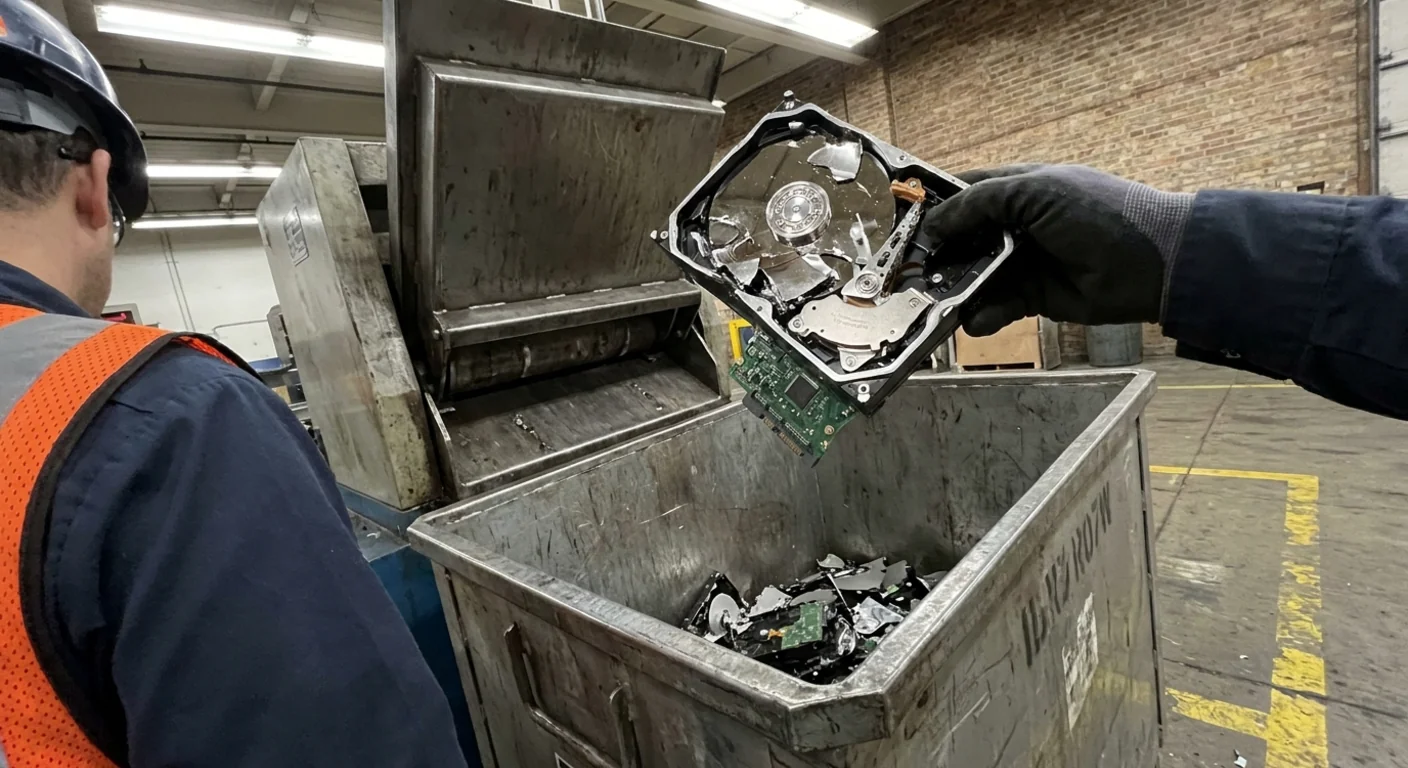
Chicago Shredder operates an on-site hard drive crusher at our Addison, Illinois facility, providing immediate physical destruction for all drive types. The industrial crusher applies thousands of pounds of pressure to bend, break, and deform hard drives beyond any possibility of data recovery. This process destroys the platters, read-write heads, circuit boards, and all internal components in a single operation.
The on-site crusher allows Chicago Shredder to maintain complete chain of custody from pickup to destruction. Clients who require witness destruction can observe the crushing process in person, watching their specific devices move through the destruction sequence. This transparency provides additional assurance for organizations with heightened security requirements.
Following destruction, the crushed material enters our electronics recycling stream where metals and other materials are recovered. This approach combines maximum security with environmental responsibility, ensuring that no materials are knowingly disposed of in landfills while maintaining the highest standards for data protection.
3. Comparing Destruction Methods: Shredding, Crushing, and Degaussing
Several physical destruction methods exist, each with distinct characteristics. Hard drive shredding reduces devices to small particles, typically quarter-inch or smaller pieces. This method provides extremely high security but generates material that may be more difficult to recycle efficiently. Shredding works effectively for all drive types and ensures complete destruction of every component.
Crushing, the method employed at Chicago Shredder's Addison facility, deforms drives through extreme pressure. The process bends platters, breaks internal components, and renders the device mechanically inoperable. Crushing maintains larger metal pieces that integrate more readily into recycling processes while achieving the same security outcome as shredding. The visual evidence of destruction is immediately apparent, with drives emerging visibly mangled and compressed.
Degaussing uses powerful magnetic fields to disrupt data on magnetic media. While effective for traditional hard disk drives, degaussing cannot destroy data on solid-state drives, which store information electronically rather than magnetically. As SSDs become increasingly common in business environments, degaussing alone no longer provides comprehensive protection. Physical destruction methods like crushing work uniformly across all storage technologies, providing consistent security regardless of drive type.
4. Alignment with DoD 5220.22-M Standard and NIST SP 800-88 Guidelines
The DoD 5220.22-M standard, widely referenced in data security discussions, specifies software-based overwriting procedures for data sanitization. While this standard addresses software wiping, it recognizes that physical destruction may be necessary when software methods cannot provide adequate assurance. Chicago Shredder's crushing process goes beyond software-based approaches by eliminating the storage media entirely.
NIST SP 800-88 guidelines provide comprehensive framework for media sanitization, categorizing methods as Clear, Purge, and Destroy. Physical destruction falls under the Destroy category, defined as rendering media unusable and preventing data recovery even with state-of-the-art laboratory techniques. The guidelines specifically identify physical destruction as appropriate for high-value assets, classified information, and situations where sanitization verification would be impractical.
Chicago businesses operating under various compliance requirements can rely on physical destruction to meet the highest standards for data elimination. While software wiping aligned with the DoD 5220.22-M standard may be sufficient for some use cases, physical destruction provides an additional layer of assurance. For organizations managing HIPAA-protected health information, GLBA-covered financial records, or confidential business data, the certainty of physical destruction supports their overall compliance posture.
5. Certificate of Destruction and Chain of Custody Documentation
Every hard drive destruction service from Chicago Shredder includes a certificate of destruction that documents the process. This certificate lists the number and type of devices destroyed, the destruction date, and the method employed.
Chain of custody documentation tracks devices from the moment Chicago Shredder takes possession through final destruction. This documentation provides a complete record of who handled the devices, when transfers occurred, and where devices were located throughout the process. For regulated industries, this paper trail demonstrates the controls your organization maintained over sensitive data throughout the disposal process.
Certificates and chain of custody records support compliance with various regulatory requirements. HIPAA's Security Rule requires covered entities to implement policies and procedures for final disposition of electronic protected health information. GLBA's Safeguards Rule mandates proper disposal of consumer information. FACTA's Disposal Rule specifically addresses destruction of consumer report information.
6. Supporting Compliance Requirements for HIPAA, GLBA, and FACTA
Healthcare organizations subject to HIPAA must ensure that electronic protected health information on discarded devices becomes unrecoverable. The Security Rule requires implementation of policies and procedures to address final disposition of ePHI and the hardware that stores it. Physical destruction of hard drives provides a method designed to support these requirements, ensuring that patient information cannot be reconstructed after device disposal.
Financial institutions and entities handling consumer financial information fall under GLBA requirements. The Safeguards Rule mandates administrative, technical, and physical safeguards to protect customer information, including proper disposal procedures. The FTC's Standards for Safeguarding Customer Information specifically identifies destruction and disposal of customer information as a required element. Hard drive destruction designed to make information unrecoverable helps financial services firms meet these obligations.
FACTA's Disposal Rule applies broadly to any business that uses consumer reports, including employers conducting background checks, landlords reviewing tenant applications, and companies evaluating credit applications. The rule requires proper disposal of information derived from consumer reports to protect against unauthorized access. Physical destruction represents a disposal method designed to satisfy FACTA's requirement that information be burned, pulverized, or shredded so that it cannot be read or reconstructed.
7. Why Chicago Businesses Choose Chicago Shredder for Hard Drive Destruction
Chicago-area businesses select Chicago Shredder for hard drive destruction because of our local presence, transparent processes, and comprehensive service. Our Addison facility provides convenient access for businesses throughout the Chicago metropolitan area, from the Loop to suburban communities. We typically respond to service requests within one business day, minimizing the time sensitive devices remain in temporary storage.
The ability to witness destruction provides an additional level of assurance that many security-conscious organizations value. Unlike services that transport drives to distant facilities or use mobile destruction units with limited visibility, Chicago Shredder welcomes clients to observe the crushing process. This transparency builds confidence that your specific devices receive proper treatment and that no materials are diverted or mishandled.
This secure process demonstrates our commitment to sustainable recycling practices, environmental stewardship, and ethical business operations. Chicago businesses benefit from a partner that combines maximum security for data destruction with responsible environmental practices.
8. Frequently Asked Questions
Is physical hard drive destruction really necessary, or is data wiping sufficient?
Physical destruction provides the highest level of assurance that data designed to be unrecoverable. While software wiping aligned with the DoD 5220.22-M standard may be appropriate for some situations, solid-state drives and certain compliance requirements benefit from the certainty of physical destruction. Organizations handling highly sensitive information often choose physical destruction to eliminate any possibility of data reconstruction.
Can I watch my hard drives being destroyed at Chicago Shredder's facility?
Yes, Chicago Shredder welcomes clients who wish to witness the destruction process at our Addison, Illinois facility. Witnessing destruction provides direct confirmation that your specific devices were properly destroyed and helps satisfy security protocols that require visual verification of the destruction process.
What happens to hard drives after they are crushed?
After crushing, the destroyed drives enter the electronics recycling stream. This approach ensures that no materials are knowingly disposed of in landfills while maintaining complete data security.
Does hard drive destruction support HIPAA compliance requirements?
Physical hard drive destruction is designed to support HIPAA's Security Rule requirements for final disposition of electronic protected health information.
How quickly can Chicago Shredder destroy our hard drives?
Chicago Shredder typically responds to service requests within one business day. Once drives arrive at our Addison facility, the crushing process takes only seconds per drive. We can accommodate both scheduled pickups and expedited destruction services for time-sensitive situations.
What types of storage devices can be physically destroyed?
Chicago Shredder's on-site crusher can destroy all types of hard drives, including traditional magnetic hard disk drives, solid-state drives, and hybrid drives. The crushing process is equally effective across all storage technologies, providing consistent security regardless of drive type or capacity.
Physical hard drive destruction provides the highest level of assurance that data designed to be unrecoverable, supporting requirements under HIPAA, GLBA, FACTA, and other regulatory frameworks. Call 866-770-2650.
Ready to schedule a pickup?
Call 866-770-2650 or request a quote online. Every pickup includes clear service documentation.