

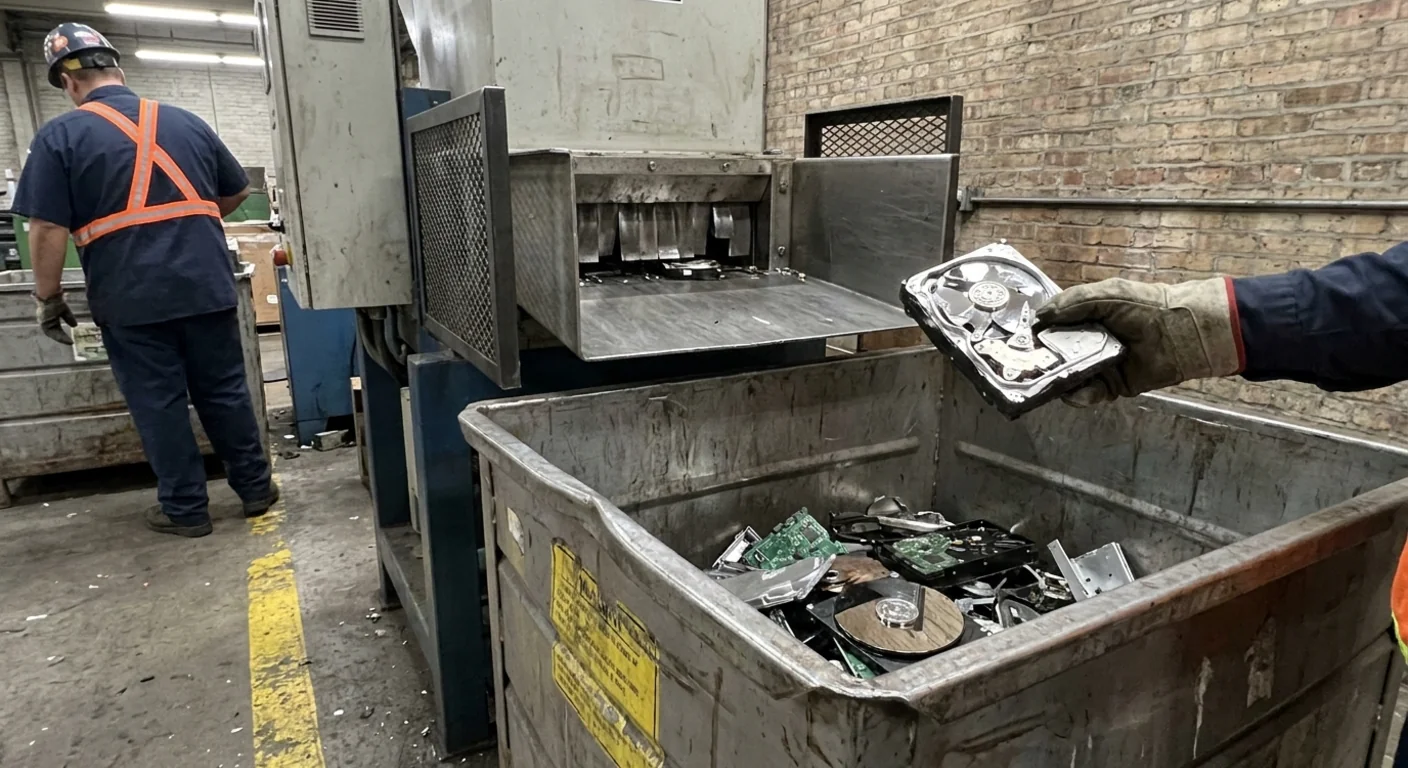
Data breaches cost organizations millions in remediation, legal fees, and reputational damage. For Chicago businesses handling sensitive customer information, financial records, or protected health data, simply deleting files or reformatting hard drives leaves critical vulnerabilities. Physical hard drive destruction represents the only method designed to render data truly unrecoverable.
1. Why Physical Destruction Matters for Data Security
Software-based data removal methods, including standard deletion and reformatting, leave data intact on the physical disk platters. Digital forensics tools can frequently recover files from drives that appear empty to operating systems. Even advanced data wiping software cannot guarantee complete data removal if the hard drive contains bad sectors or hidden areas that skip overwrite processes.
Physical destruction addresses these limitations by rendering the storage media itself unusable. When a hard drive undergoes mechanical destruction, the platters that store magnetic data are crushed, shredded, or punctured beyond any possibility of reconstruction. This approach eliminates uncertainty about whether data sanitization software executed properly or whether recovery techniques might succeed.
For organizations subject to regulatory oversight or handling highly sensitive information, physical destruction provides the highest level of assurance. Industries including healthcare, financial services, legal firms, and educational institutions routinely specify physical destruction in their data security policies. The method aligns with both DoD 5220.22-M standard requirements and NIST SP 800-88 guidelines for media sanitization when purge or destroy methods are indicated.
2. The On-Site Crusher at Our Addison, Illinois Facility
Chicago Shredder maintains an on-site hard drive crusher at our Addison, Illinois facility, providing local businesses with immediate, verifiable destruction capabilities. The industrial crusher applies thousands of pounds of force to hard drives, permanently deforming platters and rendering data recovery impossible through any known method.
The on-site approach offers several advantages over off-site destruction. Clients can witness the destruction process if desired, providing direct verification that their specific drives undergo complete destruction. This eliminates the security gap that occurs when drives leave your facility and travel to a distant destruction site. The shorter chain of custody reduces exposure time and potential interception points.
Our crusher handles all common hard drive formats, including 2.5-inch laptop drives, 3.5-inch desktop drives, and enterprise server drives. Solid-state drives (SSDs) also undergo the same crushing process, which destroys the NAND flash memory chips that store data. The mechanical destruction method works regardless of drive age, manufacturer, or storage technology.
Following destruction, the crushed materials are sorted and processed through secure recycling streams. No materials are knowingly disposed of in landfills. The metals, plastics, and other components are recovered for reuse, supporting circular economy principles while maintaining the security focus that drives the destruction process.
3. Shredding vs. Punching vs. Wiping: Comparing Destruction Methods
Organizations evaluating hard drive destruction encounter three primary approaches: shredding, punching, and data wiping. Each method offers different security levels and cost profiles. Understanding these differences helps businesses select appropriate destruction methods for various data sensitivity levels.
Shredding reduces hard drives to small particles, typically under one inch. Industrial shredders pull drives through hardened steel cutting blades that slice through metal casings and platters. This method provides extremely high security because the resulting particles are too small to contain recoverable data segments. Shredding works well for the highest-sensitivity applications but represents a higher cost per drive.
Punching or crushing applies focused mechanical force to deform drives without reducing them to particles. Our on-site crusher uses this approach, bending platters and destroying the precise magnetic alignment that stores data. This method balances strong security with operational efficiency, making it suitable for most business applications. The destroyed drives remain identifiable as hard drives but are completely nonfunctional.
Data wiping uses software to overwrite existing data multiple times with random patterns. While this approach can be effective for drives being reused or resold, it cannot be verified with the same certainty as physical destruction. Wiping also fails if drives have hardware failures that prevent complete access to all storage areas. For end-of-life drives or those containing regulated data, physical destruction provides stronger assurance.
4. Alignment with DoD 5220.22-M Standard and NIST SP 800-88 Guidelines
The DoD 5220.22-M standard, while now superseded by NIST guidelines, established foundational requirements for data sanitization that many organizations still reference. This standard specified overwrite patterns for magnetic media and recognized physical destruction as the highest security method for classified material. Physical destruction met the standard's requirements for all security classifications when properly executed and documented.
NIST SP 800-88 guidelines provide current best practices for media sanitization across federal agencies and private organizations. These guidelines define three sanitization categories: clear, purge, and destroy. The destroy category specifically addresses physical destruction methods including disintegration, incineration, pulverizing, and shredding. NIST recognizes physical destruction as appropriate when media will not be reused and when high security assurance is required.
Chicago Shredder's crushing process aligns with the destroy category requirements in NIST SP 800-88. The mechanical deformation renders drives completely nonfunctional and data unrecoverable by any known technique. This approach satisfies the guideline's objectives for high-security data sanitization while supporting downstream recycling of destroyed materials.
Organizations building data security policies often incorporate NIST SP 800-88 guidelines by reference. Specifying physical destruction for end-of-life media containing sensitive or regulated data aligns with federal best practices and demonstrates due diligence in protecting information assets.
5. Certificate of Destruction and Chain of Custody Documentation
Compliance requirements and internal audit standards typically demand documented proof that hard drives were destroyed according to specified methods. Chicago Shredder provides a certificate of destruction for each service, detailing the drives processed, destruction method used, and date of service. This certificate serves as legal documentation that data destruction occurred and meets the standard of care for sensitive information handling.
The certificate includes serial numbers or asset tags when clients provide this information during intake. This level of detail supports IT asset management systems and allows organizations to reconcile destroyed drives against equipment inventories.
Chain of custody documentation tracks drives from the moment they leave your facility until destruction completion. Our process includes secure transportation in locked vehicles, restricted access to storage areas, and controlled handling during the destruction process. Each transfer point is logged to maintain accountability and prevent unauthorized access.
These documentation practices support audit requirements across multiple regulatory frameworks.
6. Compliance Support for HIPAA, GLBA, and FACTA Requirements
Healthcare organizations subject to HIPAA requirements face specific obligations regarding protected health information (PHI) disposal. The HIPAA Security Rule requires appropriate administrative, physical, and technical safeguards to protect electronic PHI. When disposing of hardware containing ePHI, covered entities must ensure data is rendered unrecoverable.
Financial institutions governed by the Gramm-Leach-Bliley Act (GLBA) must protect customer financial information throughout its lifecycle, including disposal. The Safeguards Rule requires proper disposal methods that prevent unauthorized access. The FTC's Disposal Rule, implementing FACTA provisions, similarly requires businesses to properly dispose of consumer information. Physical destruction of hard drives containing customer financial data supports compliance with these interconnected requirements.
Educational institutions handling student records under FERPA, legal firms managing privileged client information, and businesses maintaining employee personal data all face similar obligations. While specific regulations vary, the common thread is ensuring that sensitive information designed to be unrecoverable after media disposal. Physical destruction provides a uniform solution applicable across these various regulatory contexts.
Chicago Shredder's documented destruction process is designed to support compliance verification. The combination of secure destruction methods, chain of custody tracking, and detailed certificates creates an audit trail demonstrating that your organization took reasonable steps to protect sensitive information through end-of-life. This documentation becomes particularly valuable during regulatory examinations or in response to data security questionnaires from business partners.
7. Why Local Chicago Businesses Choose Chicago Shredder
Geographic proximity matters when selecting a hard drive destruction provider. Chicago-area businesses benefit from reduced transportation time, lower logistics costs, and the ability to coordinate destruction services around their operational schedules. Our Addison, Illinois location serves the entire Chicago metropolitan area with convenient pickup scheduling and rapid turnaround.
Local service also supports relationship-based security. Working with a regional provider allows for direct communication, facility tours, and ongoing partnership rather than anonymous transaction processing. Many Chicago businesses prefer knowing exactly where their drives are processed and having a local contact for questions or special requirements.
The Chicago business community includes numerous healthcare systems, financial institutions, professional services firms, and technology companies handling substantial volumes of sensitive data. These organizations require destruction partners who understand both regulatory requirements and operational realities.
This dual commitment resonates with Chicago organizations pursuing both compliance objectives and sustainability goals.
8. Frequently Asked Questions
How does physical hard drive destruction compare to data wiping software?
Physical destruction renders the storage media itself unusable, eliminating any possibility of data recovery regardless of software sophistication. Data wiping software, while effective for drive reuse, cannot guarantee complete data removal if the drive has bad sectors or hardware issues. For end-of-life drives containing sensitive information, physical destruction provides stronger security assurance and meets higher compliance standards.
What happens to hard drives after they are crushed at your facility?
Crushed hard drives are sorted into material streams for secure recycling. Metals, plastics, and other components are recovered for reuse through environmentally responsible processes.
Do you provide documentation proving that our hard drives were destroyed?
Yes, Chicago Shredder issues a certificate of destruction for each service, detailing the destruction method, date, and drive information when provided.
Can we witness the destruction of our hard drives at your Addison facility?
Many clients choose to witness the destruction process at our Addison, Illinois facility. This option provides direct verification that your specific drives undergo complete destruction. Contact us at 866-770-2650 to arrange witnessed destruction services, which can be particularly valuable for highly sensitive applications or audit documentation purposes.
What types of hard drives can your crusher handle?
Our industrial crusher processes all common hard drive formats, including 2.5-inch laptop drives, 3.5-inch desktop drives, enterprise server drives, and solid-state drives (SSDs). The mechanical destruction method works regardless of drive age, manufacturer, storage capacity, or underlying technology, providing consistent security across varied IT equipment.
How does hard drive destruction support HIPAA compliance for healthcare organizations?
HIPAA's Security Rule requires covered entities to render electronic protected health information unrecoverable when disposing of hardware. Physical hard drive destruction is designed to support these requirements by ensuring data designed to be unrecoverable through any known method.
Protecting sensitive data through end-of-life requires more than software deletion or reformatting. Whether your organization needs one-time purges of retired equipment or ongoing destruction services, our local team understands the regulatory landscape and operational needs of Chicago businesses. Contact Chicago Shredder at 866-770-2650 to discuss your hard drive destruction requirements or schedule a secure pickup for your end-of-life storage media.
Ready to schedule a pickup?
Call 866-770-2650 or request a quote online. Every pickup includes clear service documentation.