

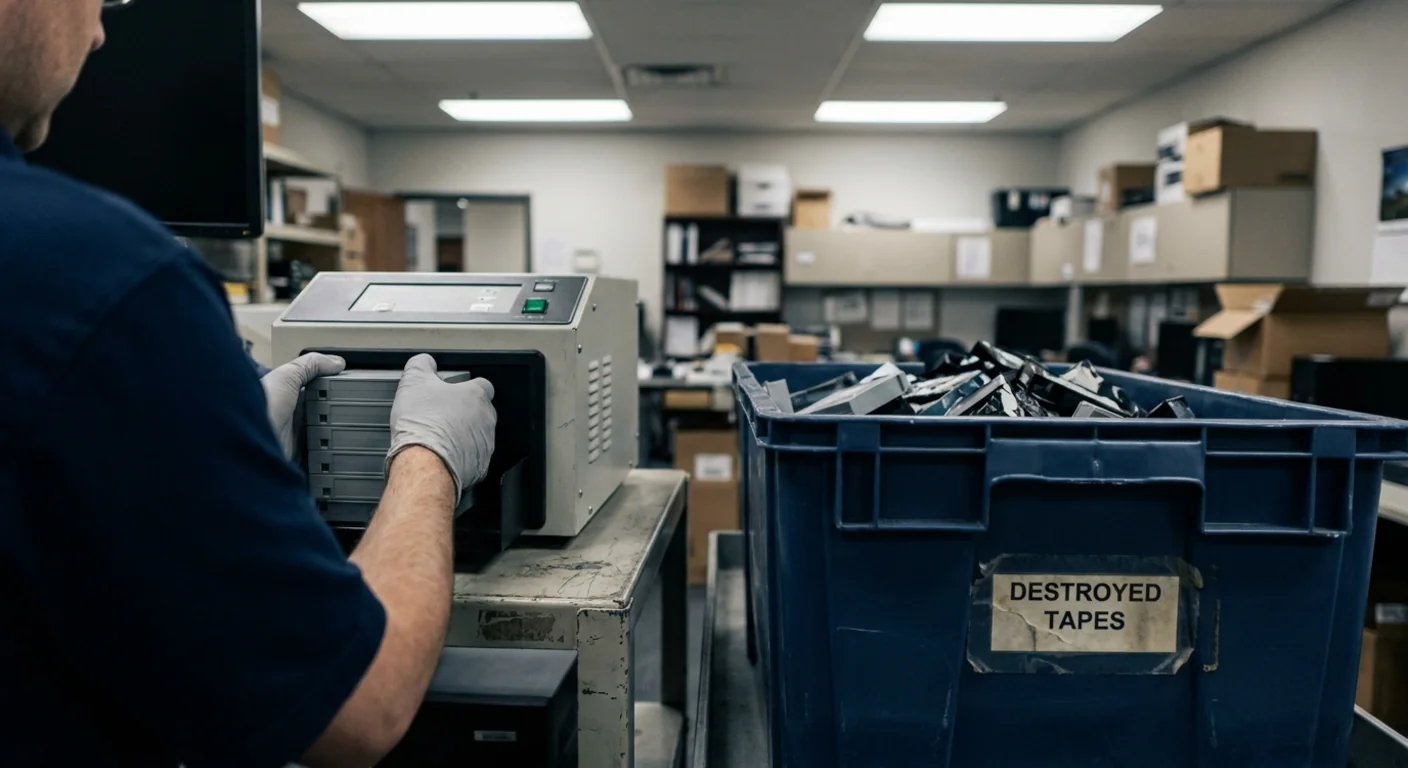
Magnetic media tapes, from LTO cartridges to DLT and DAT formats, store sensitive organizational data for years. When these tapes reach end-of-life, secure destruction becomes critical to prevent data breaches and support regulatory compliance. This guide examines physical destruction methods, compliance frameworks, and the features that define effective media tape destruction programs across the United States.
1. Why Physical Destruction Matters for Magnetic Media Tapes
Magnetic tape formats retain data through magnetic particle orientation on polyester or polymer film substrates. Unlike hard drives with firmware-based sanitization options, magnetic tapes lack native overwrite capabilities that meet contemporary security standards. Degaussing, while reducing magnetic field strength, cannot guarantee complete data elimination on high-coercivity modern tape formats.
Physical destruction provides the only method designed to render data unrecoverable from magnetic media. Industry studies suggest that mechanical shredding or punching creates particle sizes small enough to prevent any data reconstruction attempt. For organizations managing healthcare records, financial transactions, or legal documentation on tape backups, physical destruction eliminates residual risk.
Chicago Shredder operates an on-site media crusher at the Addison, Illinois facility, enabling witnessed destruction for clients requiring chain-of-custody verification. This approach addresses both security requirements and practical logistics for Chicago-area businesses retiring tape libraries.
2. Shredding vs. Punching vs. Degaussing: Comparing Destruction Methods
Media tape destruction programs typically employ one of three primary methods. Shredding uses rotating blades or hammers to reduce tapes into particles, generally ranging from 2mm to 6mm depending on equipment specifications. This method handles high volumes efficiently and produces uniform particle sizes that prevent data recovery.
Punching systems create multiple perforations through tape cartridges and media, physically disrupting the magnetic surface. While faster than shredding for individual units, punching may leave larger fragments that require additional processing. Some programs combine punching with crushing to ensure complete cartridge destruction.
Degaussing applies powerful magnetic fields to randomize magnetic particle orientation. The National Security Agency phased out degaussing-only protocols for classified media, recommending physical destruction as the terminal sanitization method. Chicago Shredder focuses on mechanical destruction methods that provide verifiable, irreversible results aligned with current best practices.
3. Alignment with DoD 5220.22-M Standard and NIST SP 800-88 Guidelines
The DoD 5220.22-M standard established overwrite specifications for electronic storage media, though it primarily addresses magnetic hard drives rather than tape formats. NIST SP 800-88 Rev. 1 guidelines provide current federal recommendations for media sanitization, categorizing methods as Clear, Purge, or Destroy. Physical destruction falls under the Destroy category, representing the most thorough sanitization approach.
NIST SP 800-88 guidelines specify that physical destruction must render data infeasible to recover using state-of-the-art laboratory techniques. For magnetic tapes, this typically requires particle sizes below 2mm square. Programs claiming alignment with these guidelines should demonstrate mechanical capabilities that meet or exceed these specifications.
Chicago Shredder's destruction processes are designed to support compliance requirements associated with DoD 5220.22-M standard and NIST SP 800-88 guidelines. The Addison facility uses industrial-grade crushing equipment calibrated for media destruction, producing results consistent with federal sanitization recommendations. Documentation provided after destruction references applicable standards, supporting audit requirements for regulated industries.
4. Certificate of Destruction and Chain of Custody Documentation
A certificate of destruction serves as legal proof that specific media items were destroyed on a particular date using specified methods. These certificates should include serial numbers when available, destruction method descriptions, facility location, and authorized signatures.
Chain of custody documentation tracks media from pickup through final destruction, identifying each person or entity handling the materials. For organizations subject to HIPAA, GLBA, or SOX requirements, unbroken chain of custody demonstrates due diligence in protecting sensitive information throughout the disposal process.
Chicago Shredder provides certificates of destruction for all media tape processing, documenting the destruction date, method, and facility location. Clients requiring witnessed destruction can schedule appointments at the Addison, Illinois facility to observe the crushing process directly. For pickup services throughout the Chicago area, secure transport maintains chain of custody from collection through processing. These documentation practices are designed to support compliance requirements and internal audit protocols.
5. Compliance Support for HIPAA, GLBA, and FACTA Requirements
Healthcare organizations subject to HIPAA regulations must ensure that electronic protected health information (ePHI) stored on backup tapes receives appropriate disposal. The HIPAA Security Rule requires covered entities to implement policies for final disposition of ePHI, including physical destruction methods designed to make information unrecoverable.
Financial institutions governed by GLBA face similar requirements for customer information disposal. The Safeguards Rule mandates administrative, technical, and physical protections throughout the information lifecycle, including secure destruction at end-of-life. FACTA's Disposal Rule extends these requirements to any business maintaining consumer reports or credit information.
Chicago Shredder's media tape destruction programs are designed to support compliance requirements across these regulatory frameworks. The combination of physical destruction methods, documented chain of custody, and secure processing provides the elements auditors expect when reviewing disposal procedures.
6. Environmental Responsibility in Media Tape Destruction Programs
Magnetic media tapes contain plastics, metals, and in some cases small amounts of hazardous materials requiring proper handling. Responsible destruction programs separate these materials for appropriate recycling or disposal, preventing unnecessary landfill contribution.
No materials are knowingly disposed of in landfills when recycling alternatives exist.
For Chicago businesses prioritizing both data security and environmental responsibility, this dual focus provides assurance that retired tape libraries receive appropriate handling. The metals recovered from tape cartridge housings re-enter manufacturing supply chains, while plastics are processed according to material type. This approach addresses corporate sustainability goals alongside information security requirements.
7. Why Local Chicago Businesses Choose Chicago Shredder for Tape Destruction
Geographic proximity matters when managing secure media destruction. Transporting backup tapes across multiple states increases handling touchpoints and extends chain-of-custody timelines. Local providers enable witnessed destruction opportunities, faster response times, and reduced transportation risk.
Chicago Shredder serves businesses throughout the Chicago metropolitan area and Illinois, with an on-site crusher at the Addison facility approximately 20 miles west of downtown Chicago. This location provides convenient access for organizations in Cook, DuPage, Will, Lake, and Kane counties requiring regular or one-time tape destruction services.
Healthcare systems, financial institutions, legal firms, and corporations across various industries use Chicago Shredder for media tape destruction as part of their information lifecycle management programs. The service is designed to integrate with existing IT asset disposition workflows, providing specialized handling for magnetic media alongside broader electronics recycling needs.
8. Frequently Asked Questions
What types of magnetic media tapes can Chicago Shredder destroy?
Chicago Shredder destroys all magnetic tape formats including LTO (Linear Tape-Open), DLT (Digital Linear Tape), DAT (Digital Audio Tape), and legacy formats like QIC and Travan cartridges. The on-site crusher at the Addison, Illinois facility handles various cartridge sizes and housing types, providing complete destruction regardless of tape generation or manufacturer.
How does physical destruction compare to degaussing for tape sanitization?
Physical destruction provides irreversible data elimination designed to meet the highest security standards, while degaussing effectiveness varies by tape coercivity and degausser strength. NIST SP 800-88 guidelines classify physical destruction as the most thorough sanitization category, recommended when data sensitivity or compliance requirements demand maximum assurance.
Can I witness the destruction of my organization's backup tapes?
Yes, Chicago Shredder accommodates witnessed destruction requests at the Addison, Illinois facility. Organizations can schedule appointments to observe the crushing process for their specific media, maintaining direct chain of custody verification. This option addresses requirements for highly sensitive data or internal audit protocols requiring visual confirmation of destruction.
What documentation does Chicago Shredder provide after tape destruction?
Chicago Shredder issues certificates of destruction documenting the destruction date, method, facility location, and material descriptions. Chain of custody documentation is available for services requiring tracked handling from pickup through final destruction, providing the documentation trail expected in regulated industries.
How quickly can Chicago Shredder process media tape destruction requests?
Chicago Shredder typically responds to service inquiries within one business day. Scheduling depends on volume, location, and whether witnessed destruction is requested. Standard pickup and destruction services for the Chicago area generally complete within one to two weeks of initial contact, while rush services may be available for urgent requirements.
Does tape destruction support HIPAA and GLBA compliance requirements?
Chicago Shredder's media tape destruction processes are designed to support compliance requirements associated with HIPAA, GLBA, FACTA, and similar regulations requiring secure information disposal. The combination of physical destruction methods, documented chain of custody, and certificates of destruction provides the elements these frameworks expect.
Physical destruction provides the most thorough sanitization approach for magnetic tapes, particularly modern high-coercivity formats that resist degaussing. Call 866-770-2650 or schedule a pickup.
Ready to schedule a pickup?
Call 866-770-2650 or request a quote online. Every pickup includes clear service documentation.