

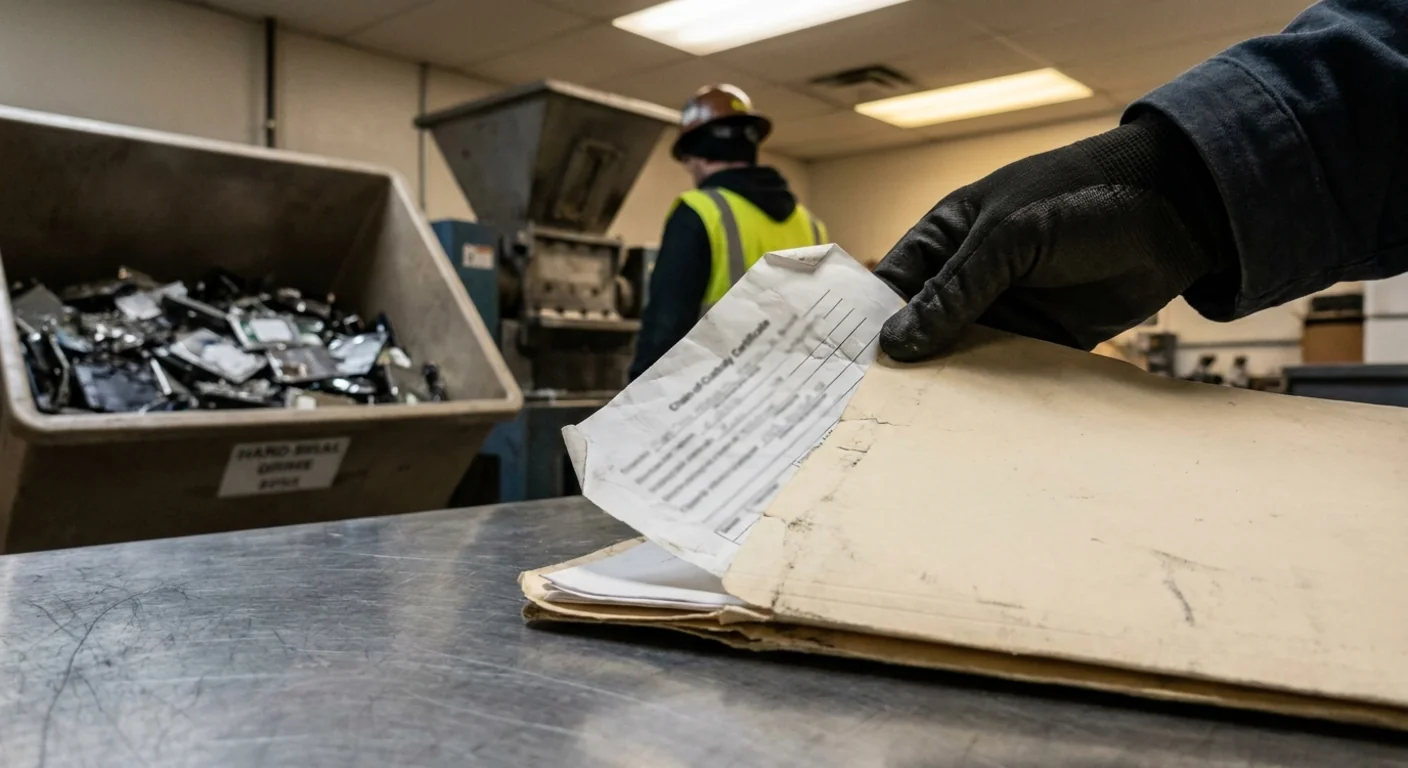
Government agencies handle sensitive citizen data, classified information, and confidential records that require the highest levels of security when equipment reaches end-of-life. From municipal offices in Chicago to state facilities across Illinois, improper disposal of hard drives and storage media creates significant risks, including data breaches, identity theft, and regulatory violations. Physical destruction remains the most reliable method for ensuring data designed to be unrecoverable.
1. Why Physical Destruction Matters for Government Data
Software-based data wiping methods can leave traces of information that sophisticated recovery techniques might retrieve. For government agencies managing personally identifiable information (PII), protected health information (PHI), tax records, and classified materials, this residual risk is unacceptable. Physical destruction fundamentally alters the storage media, making data recovery efforts futile.
Government agencies face unique accountability requirements. Citizens, oversight bodies, and auditors expect documented proof that sensitive data has been permanently destroyed. Physical destruction provides this assurance in ways that software methods cannot match. When a hard drive is physically crushed or shredded, the platters and components are rendered inoperable.
The physical destruction process is designed to be unrecoverable, giving government agencies confidence that data will not resurface through any recovery method.
2. The On-Site Hard Drive Crusher at Our Addison Facility
Chicago Shredder operates an on-site hard drive crusher at our Addison, Illinois facility, providing government agencies with immediate physical destruction capabilities. This industrial-grade equipment applies tens of thousands of pounds of pressure to hard drives, permanently deforming platters, read-write heads, and internal components. The crushing process takes seconds per drive and leaves the device visibly destroyed.
The on-site crusher eliminates transportation delays and extended holding periods. Government agencies can schedule deliveries and witness the destruction process if desired, maintaining chain of custody throughout the entire procedure. This transparency is particularly valuable for agencies with strict documentation requirements or internal audit protocols.
After crushing, the destroyed materials are sorted and processed for sustainable recycling. Metal components are separated and sent to appropriate downstream vendors. No materials are knowingly disposed of in landfills. The combination of immediate destruction and environmental responsibility makes the crushing process ideal for government agencies balancing security needs with sustainability goals.
3. Comparing Destruction Methods: Shredding, Punching, and Wiping
Government agencies evaluating data destruction options encounter three primary methods: shredding, punching, and software wiping. Each has distinct characteristics and appropriate use cases. Shredding reduces hard drives to small particles, typically less than one inch, using industrial shredders. This method provides thorough destruction and is particularly effective for high-volume processing.
Punching creates holes through hard drive platters, damaging the magnetic surfaces where data is stored. While faster than shredding, punching leaves larger remnants. Crushing, the method used at Chicago Shredder's Addison facility, sits between these approaches by deforming entire drives rather than creating specific damage patterns. The comprehensive deformation affects all internal components simultaneously.
Software wiping overwrites data multiple times following the DoD 5220.22-M standard or NIST SP 800-88 guidelines. However, software methods require functional drives, consume significant time, and may not address firmware-level vulnerabilities or hidden storage areas. For government agencies retiring equipment, many drives are already failing or damaged, making software wiping impractical. Physical destruction works regardless of drive condition and provides verifiable results that software methods cannot match.
4. Alignment with DoD 5220.22-M Standard and NIST SP 800-88 Guidelines
The DoD 5220.22-M standard has historically guided data sanitization practices for government and military organizations. This standard specifies overwrite patterns designed to make data unrecoverable through conventional recovery methods. While DoD 5220.22-M focuses on software-based sanitization, it acknowledges that physical destruction may be necessary for certain classifications or when software methods cannot be verified.
NIST SP 800-88 guidelines provide a more comprehensive framework, recognizing clear, purge, and destroy as distinct sanitization categories. The destroy category explicitly addresses physical destruction methods, including disintegration, pulverization, melting, and incineration. NIST guidelines recommend physical destruction when devices cannot be sanitized through other means or when the data sensitivity demands the highest assurance level.
Chicago Shredder's physical destruction services are designed to support compliance requirements under both frameworks. The crushing process at our Addison facility aligns with NIST's destroy category by rendering storage media unusable. This approach addresses both the security objectives outlined in these guidelines and the practical needs of agencies managing equipment disposal.
5. Certificate of Destruction and Chain of Custody Documentation
Government agencies require verifiable documentation proving that data destruction occurred according to specified procedures. Chicago Shredder provides certificates of destruction for every service, detailing the date, method, and materials processed. These certificates serve as legal records for compliance audits, internal reviews, and response to information requests.
Chain of custody documentation tracks assets from initial pickup through final destruction. Each drive or device is logged with serial numbers, asset tags, and other identifying information. This tracking prevents loss, unauthorized access, or confusion about which devices have been processed. For government agencies with strict accountability requirements, chain of custody documentation is essential.
The certificate and tracking system creates a complete audit trail. If questions arise months or years after destruction, agencies can reference specific certificates showing exactly when and how particular devices were processed.
6. Supporting Compliance with HIPAA, GLBA, and FACTA Requirements
Government agencies frequently handle information subject to federal privacy regulations. Health departments manage protected health information under HIPAA. Financial services regulators and treasury departments handle data covered by the Gramm-Leach-Bliley Act (GLBA). Any agency collecting consumer information may be subject to Fair and Accurate Credit Transactions Act (FACTA) disposal requirements. Proper data destruction is designed to support compliance requirements across these frameworks.
HIPAA requires covered entities and business associates to implement policies and procedures for electronic media disposal. The Security Rule specifically addresses media disposal, requiring methods that render protected health information unusable, unreadable, or indecipherable.
GLBA and FACTA both mandate secure disposal of consumer information. FACTA's Disposal Rule applies to any entity that maintains or possesses consumer information, including government agencies. Physical destruction ensures that credit reports, financial records, and personal data cannot be reconstructed after disposal. Chicago Shredder's services are designed to support compliance with these requirements, helping government agencies meet their regulatory obligations while managing IT asset retirement.
7. Why Chicago and Illinois Government Offices Choose Local Data Destruction
Government agencies across the Chicago metropolitan area and throughout Illinois benefit from working with a local data destruction provider. Chicago Shredder's Addison facility is centrally located, allowing for efficient pickup and delivery arrangements. Local service reduces transportation time, lowers costs, and minimizes the environmental impact of long-distance shipping.
Responsiveness matters when government agencies have specific timelines or sudden needs. We typically respond within one business day to service requests, accommodating urgent destruction requirements or scheduled equipment refreshes. Local presence means agency staff can visit the facility, observe destruction processes, and verify that procedures meet their standards. This transparency builds confidence and supports internal approval processes.
Working with a Chicago-area company also supports the local economy and aligns with sustainability initiatives many government agencies pursue. This secure process demonstrates commitment to environmental responsibility and worker safety standards.
8. Frequently Asked Questions
What happens to hard drives after they are physically destroyed?
After crushing at our Addison facility, destroyed hard drives are sorted by material type. Metal components are separated and sent to appropriate recycling vendors. No materials are knowingly disposed of in landfills, ensuring environmentally responsible processing while maintaining data security.
Can government agencies witness the destruction of their equipment?
Yes, Chicago Shredder accommodates witness destruction requests at our Addison facility. Government staff can observe the crushing process, verify serial numbers, and confirm that their specific devices are destroyed according to procedures. This transparency supports chain of custody requirements.
How does physical destruction compare to degaussing for data security?
Degaussing disrupts magnetic fields on traditional hard drives but does not work on solid-state drives (SSDs) and leaves the physical device intact. Physical destruction works on all storage media types regardless of technology and renders the device visibly unusable, providing clear verification of destruction.
Which regulatory requirements may apply to this topic?
We provide certificates of destruction detailing the date, method, and materials processed, along with chain of custody documentation tracking each asset from pickup through final destruction. These records support compliance audits under HIPAA, GLBA, FACTA, and other regulatory frameworks.
Does data destruction service include pickup from government facilities?
Yes, Chicago Shredder offers pickup services for government agencies throughout the Chicago area and Illinois. We coordinate scheduling to meet agency requirements and maintain secure chain of custody during transportation to our Addison facility.
Are your destruction methods aligned with federal standards?
Our physical destruction processes are designed to support compliance requirements under the DoD 5220.22-M standard and NIST SP 800-88 guidelines.
Government agencies in Chicago and across Illinois face complex requirements when retiring IT equipment containing sensitive data. From the on-site crusher at our Addison facility to comprehensive certificates of destruction, Chicago Shredder offers government agencies a complete solution for secure data destruction. Our local presence, transparent processes, and commitment to environmental responsibility make us a trusted partner for municipal, county, state, and federal offices managing IT asset disposal. For more information about secure data destruction services designed for government agencies, call Chicago Shredder at 866-770-2650 or schedule a pickup today.
Ready to schedule a pickup?
Call 866-770-2650 or request a quote online. Every pickup includes clear service documentation.