

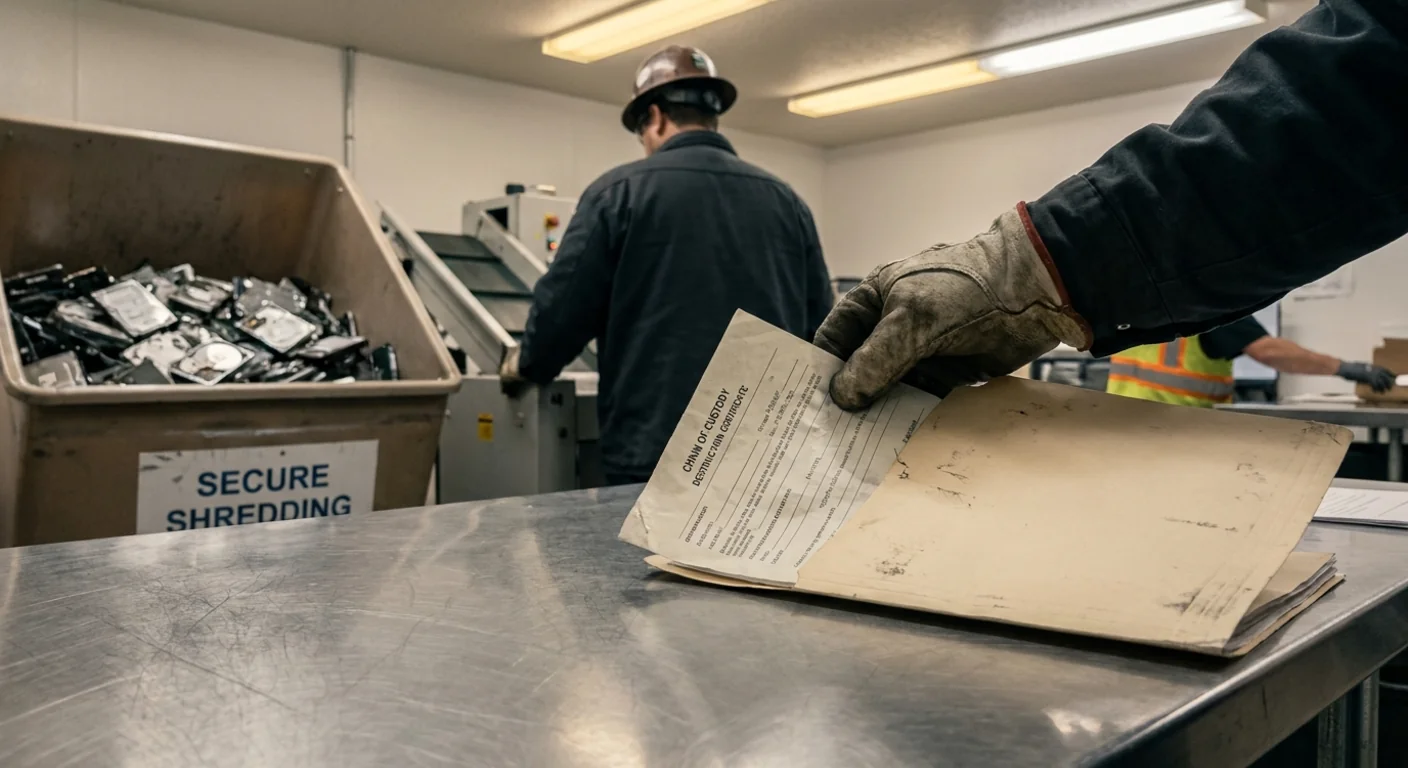
Large corporations handle massive volumes of sensitive data across thousands of devices. When hard drives, servers, and storage equipment reach end of life, the data they contain becomes a significant liability. A single improperly disposed drive can expose customer records, financial information, trade secrets, or employee data. For businesses operating in Illinois and throughout the Midwest, secure data destruction is not just a best practice, it's a fundamental requirement for protecting stakeholders and maintaining regulatory compliance. Chicago Shredder provides enterprise-grade data destruction services designed to eliminate these risks.
1. Why Physical Destruction Matters for Enterprise Data Security
Software-based data erasure methods can be appropriate for devices remaining in service, but they introduce variables that large corporations cannot afford. Wiping software requires functional hardware, compatible interfaces, and verification protocols that may fail without detection. Even when performed correctly, sophisticated data recovery techniques have demonstrated that overwritten data can sometimes be partially reconstructed under laboratory conditions.
Physical destruction eliminates these uncertainties. When a hard drive platter is mechanically shredded or crushed, the data becomes designed to be unrecoverable through any known method. This approach is particularly critical for corporations handling regulated data under HIPAA, GLBA, FACTA, or similar frameworks. The physical destruction method provides the highest assurance level that sensitive information will not be exposed.
Chicago Shredder prioritizes physical destruction methods because they deliver measurable, verifiable results. Our processes are designed to support compliance requirements while providing the documentation that enterprise risk management teams require. For corporations managing hundreds or thousands of devices annually, this certainty is essential.
2. On-Site Hard Drive Crushing at the Addison, Illinois Facility
Chicago Shredder operates an on-site hard drive crusher at our Addison, Illinois facility. This industrial equipment applies thousands of pounds of force to physically deform hard drives, rendering the internal platters and data structures completely unusable. The crushing process creates permanent physical damage that makes data reconstruction impossible through standard recovery methods.
The on-site crusher serves several strategic purposes for corporate clients. First, it enables rapid processing of large device volumes without shipping materials to distant facilities. Second, it maintains chain of custody within our controlled environment. Third, it allows corporate security teams to witness the destruction process when desired, providing additional verification.
After crushing, materials are segregated for responsible downstream processing. This ensures that no materials are knowingly disposed of in landfills and that commodity recovery follows industry-leading environmental standards. Corporate clients receive documentation confirming both the destruction event and the responsible handling of resulting materials.
3. Comparing Data Destruction Methods: Shredding, Punching, and Wiping
Corporations evaluating data destruction vendors encounter three primary methods: physical shredding, hole punching, and software wiping. Each has distinct characteristics that affect security outcomes, processing speed, and cost structures.
Physical shredding reduces hard drives to small fragments, typically less than one inch. Industrial shredders process drives through rotating blades or hammers that pulverize platters, circuit boards, and enclosures simultaneously. This method provides the highest physical security level and is preferred for highly sensitive data. Shredding accommodates mixed media types, including solid-state drives, in a single process stream.
Hole punching uses hydraulic or mechanical force to drive a punch through the drive enclosure and platter stack. While faster than shredding, this method leaves larger fragments intact. Some data recovery experts note that information outside the punch zone may remain on platter surfaces. Crushing, the method used at our Addison facility, applies force across the entire drive body, creating comprehensive deformation that exceeds hole punching's security level.
Software wiping follows protocols like the DoD 5220.22-M standard or NIST SP 800-88 guidelines to overwrite data multiple times. This method allows drive reuse but requires functional hardware and extensive quality verification. For corporations prioritizing absolute security over potential resale value, physical methods remain the superior choice.
4. Alignment with DoD 5220.22-M Standard and NIST SP 800-88 Guidelines
The DoD 5220.22-M standard and NIST SP 800-88 guidelines provide frameworks that government agencies and corporations reference when developing data destruction policies. Understanding how physical destruction methods relate to these documents helps enterprise security teams make informed decisions.
The DoD 5220.22-M standard specifies overwrite patterns for software-based sanitization. While this standard addresses wiping procedures, it also recognizes that physical destruction represents a valid alternative when overwriting is impractical or when maximum security is required. The standard acknowledges that certain threat models necessitate physical media destruction rather than sanitization.
NIST SP 800-88 guidelines provide a more comprehensive framework covering sanitization, purging, and destruction. These guidelines explicitly describe physical destruction methods including disintegration, pulverization, melting, and incineration. NIST recognizes physical destruction as appropriate for media containing highly sensitive information or when reuse is not intended. The guidelines emphasize that destruction methods should render data infeasible to recover using state-of-the-art laboratory techniques.
Chicago Shredder's crushing and shredding processes align with the physical destruction approaches outlined in NIST SP 800-88 guidelines. Our methods are designed to create the irreversible physical damage that these frameworks describe as effective for data protection. Corporate clients developing internal policies can reference these widely recognized guidelines when justifying physical destruction as their chosen approach.
5. Certificate of Destruction and Chain of Custody Documentation
Enterprise data destruction requires comprehensive documentation to satisfy internal auditors, external regulators, and risk management protocols. Two critical documents support this requirement: certificates of destruction and chain of custody records.
A certificate of destruction provides formal documentation that specific devices were destroyed on a particular date using defined methods. Chicago Shredder issues certificates that include service date, destruction method, device counts or serial numbers as provided, and authorized signatures.
Chain of custody documentation tracks devices from corporate possession through final destruction. This record establishes who handled materials at each transfer point, when transfers occurred, and under what security protocols. For corporations handling regulated data, unbroken chain of custody is often a compliance requirement. Our documentation practices are designed to support these audit trails.
When corporations ship devices to our Addison facility or arrange on-site pickup, we typically respond within one business day to begin the documentation process. Materials are inventoried upon receipt, secured in controlled areas, and processed according to service agreements. The resulting documentation package provides the evidence that corporate governance teams need to close out asset retirement processes and satisfy their data protection obligations.
6. Compliance Support for HIPAA, GLBA, and FACTA Requirements
Healthcare corporations, financial institutions, and businesses handling consumer credit information operate under strict data protection regulations. HIPAA, GLBA, and FACTA each establish requirements for safeguarding information and properly disposing of media containing sensitive data. Chicago Shredder's services are designed to support compliance with these frameworks.
HIPAA requires covered entities and business associates to implement policies for disposing of electronic media containing protected health information. The Security Rule specifically addresses media disposal and emphasizes rendering data unusable and inaccessible. Physical destruction methods directly address these requirements by ensuring that patient information cannot be reconstructed from disposed devices.
GLBA obligates financial institutions to protect customer information throughout its lifecycle, including disposal. The Safeguards Rule requires administrative, technical, and physical safeguards appropriate to the sensitivity of the information. Engaging specialized data destruction services with documented processes demonstrates the due diligence that regulators expect.
FACTA's Disposal Rule applies to any business that uses consumer reports or information derived from them. The rule requires proper disposal of consumer information to protect against unauthorized access. Physical destruction of hard drives and electronic media containing this information represents a straightforward method for satisfying the rule's requirements. Our destruction processes and documentation are designed to support compliance audits under these regulatory frameworks.
7. Why Chicago Corporations Choose Local Data Destruction Services
Large corporations operating in Illinois increasingly prefer working with local data destruction providers rather than national chains or distant facilities. Several strategic factors drive this preference, particularly for businesses with significant operations in the Chicago metropolitan area.
Proximity reduces transportation costs and security risks. Shipping hard drives across state lines or to distant regions increases the opportunity for loss, theft, or documentation gaps in chain of custody. Chicago Shredder's Addison facility serves the entire metropolitan area with minimal transit time, allowing corporations to maintain tighter control over sensitive assets until destruction.
Local providers offer greater flexibility for specialized requirements. When corporations need witnessed destruction, expedited processing, or custom documentation, working with a nearby facility simplifies coordination. Our team can accommodate site visits, adjust processing schedules, and respond to unique corporate governance requirements that large national operations may struggle to address.
Supporting regional businesses aligns with corporate sustainability and community investment goals. Many Illinois corporations maintain formal supplier diversity and local procurement policies. Engaging Chicago Shredder supports these initiatives while delivering the technical security outcomes that enterprise data protection requires.
8. Frequently Asked Questions
How does physical destruction compare to degaussing for hard drive data security?
Degaussing uses powerful magnetic fields to disrupt data on magnetic media. While effective for traditional hard drives, it does not work on solid-state drives and leaves devices physically intact. Physical destruction methods like crushing or shredding work on all device types and provide visual confirmation of destruction, making them more versatile for mixed corporate IT environments.
Can we witness the destruction of our hard drives at your facility?
Yes, Chicago Shredder can accommodate witnessed destruction for corporate clients with specific security protocols. Our Addison facility allows authorized representatives to observe the crushing process, providing additional verification for highly sensitive projects. Contact our team at 866-770-2650 to arrange witnessed destruction services.
What happens to the materials after hard drives are crushed or shredded?
After destruction, materials are sorted and prepared for downstream processing. Metals, plastics, and other commodities are recovered according to sustainable recycling standards, and no materials are knowingly disposed of in landfills.
How quickly can you process large volumes of corporate hard drives?
Processing timelines depend on project scope and current volumes, but we typically respond within one business day to begin coordinating large corporate projects. Our on-site crusher at the Addison facility enables efficient processing of significant device quantities. Contact us to discuss your specific timeline requirements and volume.
Do you provide serial-level tracking for certificate of destruction?
Yes, when corporations provide serial number inventories, we can include this information in certificates of destruction. Serial-level tracking supports detailed asset management systems and provides the granular documentation that some compliance frameworks require. Discuss your tracking requirements when scheduling service.
What security measures protect our devices before destruction?
Devices are secured in controlled areas from receipt through destruction. Our facility maintains access controls, video surveillance, and inventory management systems designed to prevent unauthorized access. Chain of custody documentation tracks materials throughout the process, providing the security assurance that corporate governance teams require.
Large corporations face escalating data security risks as device volumes grow and regulatory requirements expand. Physical destruction methods provide the highest assurance that sensitive information will not be exposed through disposed hard drives and electronic media. Chicago Shredder's on-site crusher at our Addison, Illinois facility, combined with comprehensive documentation and responsible downstream processing, delivers the security outcomes that enterprise risk management demands. Our services are designed to support compliance requirements under HIPAA, GLBA, FACTA, and similar frameworks while maintaining the chain of custody that auditors expect. Call 866-770-2650 or schedule a pickup.
Ready to schedule a pickup?
Call 866-770-2650 or request a quote online. Every pickup includes clear service documentation.