

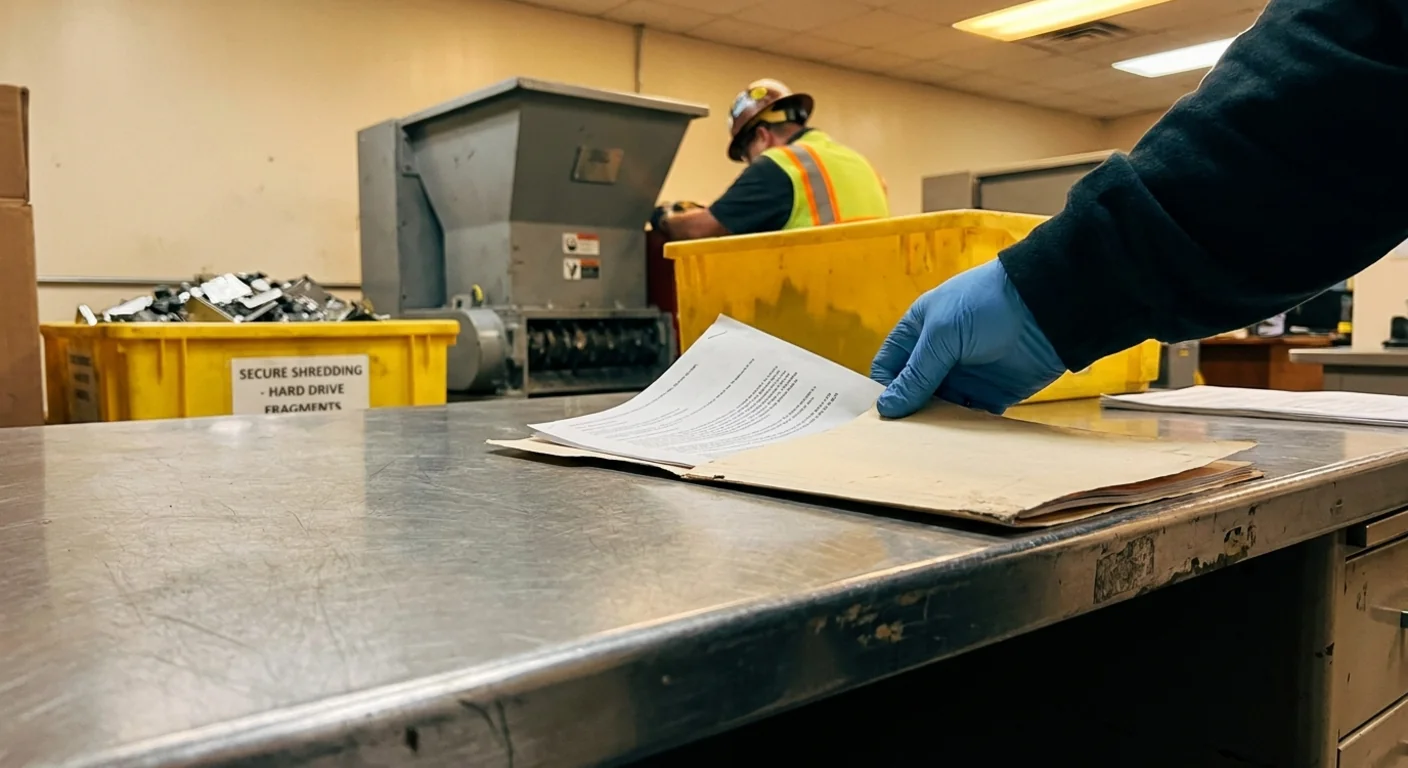
Small business owners in the Chicago area handle sensitive data every day, from customer payment information to employee records and proprietary business intelligence. When hard drives, computers, or servers reach end-of-life, simply deleting files or reformatting drives leaves data vulnerable to recovery by determined individuals. Physical data destruction provides the most secure method to protect your business, your customers, and your reputation.
1. Why Physical Destruction Matters More Than Software Wiping
Software-based data wiping tools overwrite existing data multiple times, following patterns designed to make recovery difficult. While these methods align with NIST SP 800-88 guidelines for sanitization, they depend on proper execution and cannot guarantee results if drives have bad sectors or hidden areas that writing processes miss. Recovery tools continue to advance, and sophisticated data forensics can sometimes extract fragments from supposedly wiped drives.
Physical destruction eliminates this risk entirely by rendering the storage media mechanically unusable. When a hard drive passes through a crusher or shredder, the platters that store magnetic data become bent, fractured, and separated from their housings. The physical deformation of the platters makes data recovery functionally impossible, regardless of the tools or expertise applied. This approach works equally well on traditional spinning hard drives and solid-state drives.
For small businesses handling customer financial data, protected health information, or other regulated information, physical destruction provides the highest level of assurance. The method does not depend on software compatibility, does not require hours of processing time per drive, and creates an audit trail through certificates of destruction that document the process.
2. The On-Site Hard Drive Crusher at Our Addison Facility
Chicago Shredder operates an on-site hard drive crusher at our Addison, Illinois facility, allowing us to physically destroy drives immediately upon receipt. The crusher applies thousands of pounds of force to bend and break hard drive platters, making the data stored on them designed to be unrecoverable.
The crushing process works on various drive form factors, from 3.5-inch desktop drives to 2.5-inch laptop drives and smaller formats. The crusher deforms the entire drive assembly, ensuring that platters, circuit boards, and connectors all sustain damage.
Small business owners can witness the destruction process if desired, providing additional verification that drives containing their sensitive data have been properly destroyed. This transparency builds confidence in the security measures protecting your information from the moment drives leave your facility until destruction is complete.
3. Comparing Destruction Methods: Shredding, Punching, and Crushing
Three primary physical destruction methods serve different needs and budgets. Hard drive shredding reduces drives to small particles, typically less than one inch in size, by passing them through rotating blades or hammers. This method achieves the most complete destruction but generates more waste processing steps. Shredding provides the highest security level for organizations with extremely sensitive data or strict regulatory requirements.
Hole punching drives a spike through the drive casing and platters, creating a physical breach that disrupts data storage areas. While faster and less expensive than shredding, punching leaves larger pieces intact and may not affect all platters equally in multi-platter drives. Some security experts consider punching adequate for less sensitive data but insufficient for high-security applications.
Crushing strikes a balance between thoroughness and efficiency. The process bends and fractures platters throughout their surface area, affecting all platters in a drive simultaneously. Crushing achieves destruction levels aligned with the DoD 5220.22-M standard for physical media destruction while processing drives quickly. For most small businesses, crushing provides appropriate security at reasonable cost, making it the most practical choice for regular IT equipment retirement cycles.
4. Alignment with DoD 5220.22-M Standard and NIST Guidelines
The DoD 5220.22-M standard outlines methods for clearing, purging, and destroying data on various media types. The physical destruction methods described in DoD 5220.22-M include disintegration, incineration, pulverization, shredding, and melting. Crushing meets the standard's requirements by rendering data recovery infeasible through mechanical deformation.
NIST SP 800-88 guidelines provide a framework for media sanitization decisions based on data confidentiality levels and media types. The guidelines recognize three levels: clear, purge, and destroy. Physical destruction falls under the destroy category, appropriate for media containing highly sensitive information or when organizations need absolute assurance that data designed to be unrecoverable. Small businesses handling customer data, financial records, or proprietary information often find physical destruction the most appropriate choice.
Chicago Shredder's processes are designed to align with both the DoD standard and NIST guidelines, providing small business owners with methods that meet recognized security frameworks. This alignment becomes particularly important when businesses need to demonstrate due diligence in protecting sensitive information to customers, partners, or regulatory bodies.
5. Certificates of Destruction and Chain of Custody Documentation
After destroying your hard drives and data storage media, Chicago Shredder provides certificates of destruction that document the process. These certificates include details about the drives destroyed, the destruction method used, the date of destruction, and witness signatures when applicable. The documentation creates an auditable record proving that your business took appropriate steps to protect sensitive information.
Chain of custody tracking begins when equipment leaves your facility and continues through transportation, receiving, storage, destruction, and final disposition of materials. Each transfer point is documented, creating a complete record of who handled the drives and when. This tracking system addresses security concerns about data leaving your control and provides accountability throughout the process.
Small businesses facing audits, compliance reviews, or customer inquiries about data handling practices can present these certificates as evidence of proper data destruction procedures. The documentation supports your privacy policies and demonstrates commitment to protecting customer information. Many businesses retain these certificates for several years as part of their compliance documentation, particularly in regulated industries.
6. Supporting Compliance Requirements for HIPAA, GLBA, and FACTA
Healthcare practices handling protected health information under HIPAA regulations must ensure proper disposal of electronic media containing patient data. The HIPAA Security Rule requires covered entities to implement policies and procedures for final disposition of electronic protected health information and the hardware containing it. Physical destruction of hard drives before disposing of computers or servers is designed to support these compliance requirements.
Financial services firms subject to the Gramm-Leach-Bliley Act face similar obligations to protect customer financial information. The GLBA Safeguards Rule requires financial institutions to dispose of customer information in a manner designed to prevent unauthorized access. The Fair and Accurate Credit Transactions Act extends these requirements to businesses handling consumer credit information, requiring proper disposal of records containing personal information.
Small businesses in these sectors or those handling similar types of sensitive data can use physical destruction services as part of their compliance programs. Working with a local Illinois service provider familiar with these frameworks helps businesses demonstrate good faith efforts to protect customer information.
7. Why Chicago Small Businesses Choose Local Data Destruction
Working with a Chicago-area data destruction provider offers practical advantages over national services or attempting destruction in-house. Local pickup and processing reduces the time sensitive data spends in transit and allows for more flexible scheduling around your business needs. When you need to retire equipment quickly or have specific timing requirements, a local provider typically responds within one business day to arrange service.
The proximity of our Addison facility to Chicago businesses means shorter transportation distances and the option for on-site witnessing of destruction when desired. Small business owners can visit the facility, observe the crushing process, and leave with certificates in hand the same day. This level of accessibility and transparency proves difficult to achieve with distant facilities or mail-in services.
For Chicago small business owners who value both security and environmental responsibility, this combination addresses both priorities.
8. Frequently Asked Questions
How is hard drive crushing different from degaussing?
Crushing physically destroys the hard drive platters through mechanical force, while degaussing uses powerful magnets to disrupt magnetic fields on traditional hard drives. Crushing works on both traditional hard drives and solid-state drives, whereas degaussing only affects magnetic media and does not work on SSDs. Physical destruction through crushing provides visual confirmation that drives are destroyed and generates certificates documenting the process.
Can I just remove hard drives from computers before recycling and keep them?
While you can remove drives before recycling computers, storing old drives creates ongoing security risks and eventual disposal challenges. Drives degrade over time, and data remains accessible if someone gains access to stored drives. Including drives in your IT asset disposal process ensures they are destroyed properly rather than accumulating as a security liability.
Do I need to wipe drives before sending them for physical destruction?
Pre-wiping is not necessary when drives will be physically destroyed, as the crushing process makes data recovery designed to be unrecoverable. However, some businesses choose to wipe drives as an additional precaution or because their internal policies require it. The physical destruction provides the primary security measure.
What happens to the materials after hard drives are crushed?
Destroyed hard drives contain valuable materials including aluminum, steel, copper, and precious metals. No materials are knowingly disposed of in landfills.
How long should I keep certificates of destruction?
Retention periods vary by industry and regulation, but many businesses keep destruction certificates for three to seven years as part of their compliance documentation. Healthcare organizations often retain them longer to match medical record retention requirements. Consult with your legal or compliance advisor about appropriate retention periods for your specific situation.
Can you destroy other types of media besides hard drives?
Yes, Chicago Shredder handles various data storage media including solid-state drives, backup tapes, CDs, DVDs, USB drives, and mobile devices. Different media types may use different destruction methods appropriate to their construction, but the goal remains the same: making data recovery designed to be unrecoverable while allowing material recovery where possible.
Data destruction represents a critical component of information security for small businesses throughout the Chicago area. Physical destruction methods, particularly hard drive crushing at our Addison facility, provide the highest level of assurance that sensitive customer, employee, and business data designed to be unrecoverable after equipment retirement. The process aligns with recognized standards including DoD 5220.22-M and NIST SP 800-88 guidelines, supports compliance requirements under regulations like HIPAA and GLBA, and generates documentation proving proper handling. For small business owners ready to retire computers, servers, or other equipment containing hard drives, Chicago Shredder offers local expertise and transparent processes. Call 866-770-2650 to discuss your data destruction needs or schedule a pickup at your convenience.
Ready to schedule a pickup?
Call 866-770-2650 or request a quote online. Every pickup includes clear service documentation.