

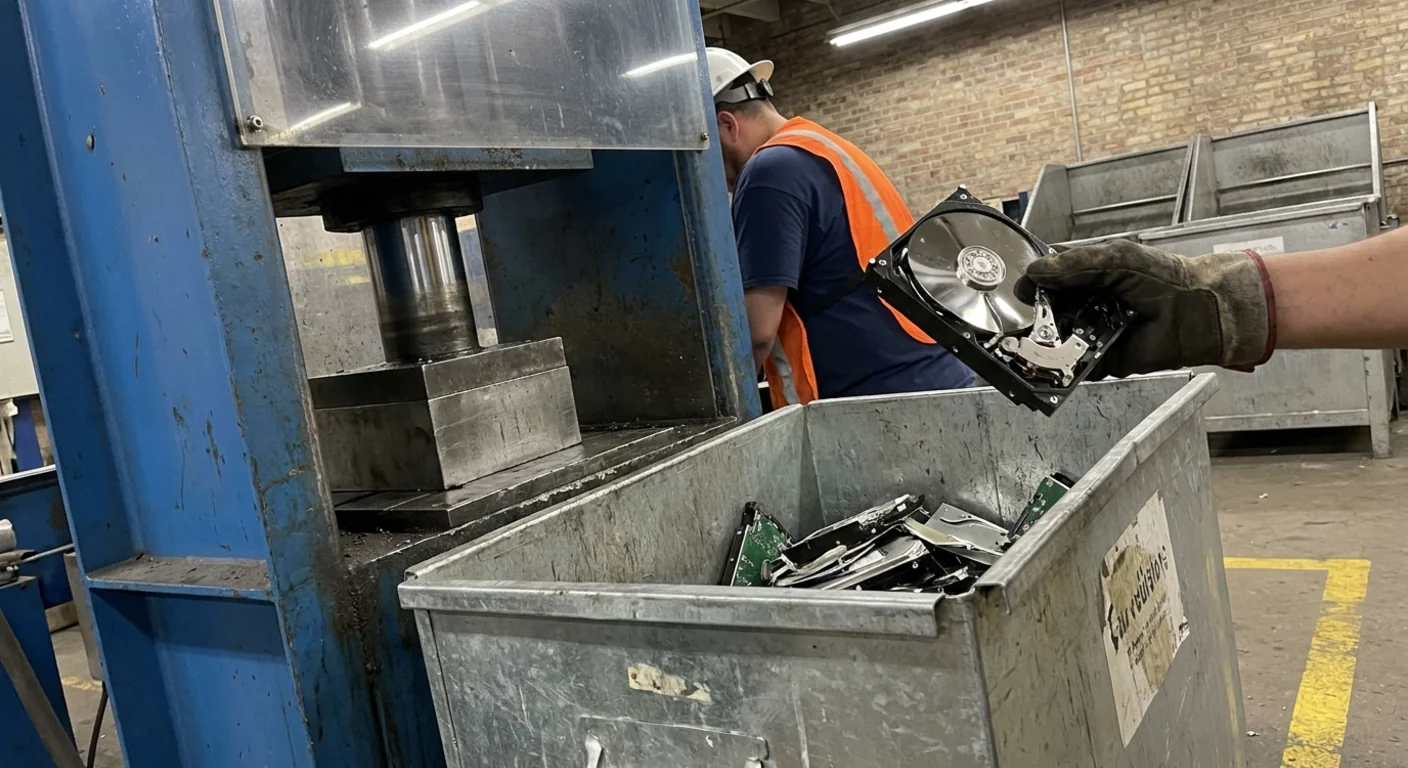
The average cost of a data breach in the United States reached $9.48 million in 2023, according to IBM Security's Cost of a Data Breach Report, with healthcare organizations facing an even steeper $10.93 million per incident. For IT managers, compliance officers, healthcare administrators, and financial institution risk managers in the Chicago metro area, selecting the right hard drive destruction method is a documented control point in vendor oversight programs required by HIPAA, GLBA, and FACTA disposal rules. No drives leave the facility intact. This guide examines the five destruction methods most commonly specified by Chicago organizations evaluating secure disposition vendors and the regulatory frameworks that shape method selection.
Definition
Hard Drive Destruction Methods: Hard drive destruction methods are physical or technical processes that render data stored on magnetic, solid-state, or hybrid storage media unrecoverable. NIST Special Publication 800-88 Revision 1 categorizes these methods into Clear, Purge, and Destroy, with Destroy methods such as shredding, crushing, and disintegration providing the highest assurance by physically damaging the media.
Key Takeaways
- Physical shredding, degaussing, crushing, disintegration, and incineration are the five primary destruction methods specified in NIST SP 800-88 Revision 1 for rendering hard drive data unrecoverable.
- Healthcare systems subject to HIPAA Security Rule device and media control standards typically require witnessed physical destruction with serialized certificates traceable to specific drive serial numbers.
- Financial institutions under GLBA Safeguards Rule audits maintain vendor oversight programs verifying that destruction providers implement documented information security controls and employee screening consistent with the institution's written information security program.
- Degaussing is effective only for magnetic media and cannot sanitize solid-state drives, optical media, or hybrid drives containing flash memory components.
- Illinois Electronic Products Recycling and Reuse Act (415 ILCS 150) bans covered electronic devices including computers from landfill disposal, requiring manufacturer-funded collection and recycling statewide.
1. What Are the Top 5 Hard Drive Destruction Methods Used by Chicago Businesses?
The five methods most commonly used are physical shredding, degaussing, crushing, disintegration, and incineration. Each method addresses different media types and security categorizations defined in NIST SP 800-88 Revision 1, with physical shredding and crushing representing the majority of requests from healthcare systems, financial institutions, and law firms in the Chicago metro area.
Physical shredding reduces hard drives to small particles using industrial shredders, rendering platters and circuits unreadable. Explore NIST SP 800-88 Rev. 1, Guidelines for Media Sanitization, shredding is classified as a Destroy method when particle size and process controls meet security requirements. Degaussing applies a strong magnetic field to erase data on magnetic media but is ineffective on solid-state drives. Crushing uses hydraulic force to deform platters and break internal components, a method favored by organizations requiring witnessed destruction at vendor facilities. Disintegration and pulverization physically break drives into fragments, often specified when devices contain classified or highly sensitive information. Incineration uses high-temperature combustion to destroy media, though it is less common in urban Chicago areas due to environmental regulations and facility permitting. Healthcare systems and financial institutions in the Chicago metro service areas. The choice among these five methods depends on media type, regulatory obligations under HIPAA, GLBA, and FACTA, and whether the organization's risk assessment requires witnessed destruction or accepts off-site processing with certificate documentation.
2. How Does Physical Shredding Meet NIST 800-88 Destroy Requirements?
Physical shredding meets NIST 800-88 Destroy requirements by reducing hard drives to particles small enough that data recovery is infeasible. The guidelines specify that Destroy methods must damage the media to the point where even state-of-the-art laboratory techniques cannot reconstruct data, a standard that industrial shredders achieve when particle size and process documentation are properly controlled.
NIST SP 800-88 Revision 1 defines Destroy as the highest sanitization category, requiring that "the media cannot be reused as originally intended and that data recovery is infeasible using state-of-the-art laboratory techniques." Physical shredding accomplishes this by mechanically cutting hard drive platters, circuit boards, and enclosures into fragments typically measuring 1 inch or smaller, depending on the shredder specification. The on-site hard drive crusher at the Addison, IL facility operated by Chicago Shredder provides witnessed physical destruction that meets DoD-standard requirements, with no drives leaving the facility intact. Healthcare administrators evaluating hard drive disposal and witnessed destruction services for HIPAA compliance verify that shredding processes generate serialized certificates of destruction traceable to specific drive serial numbers, a control required by business associate agreements and device and media control standards in 45 CFR 164.310(d)(1). Financial institutions subject to GLBA Safeguards Rule audits (16 CFR Part 314) maintain vendor oversight programs that confirm shredding providers implement documented information security controls, secure facility access, and employee screening consistent with the institution's own written information security program requirements. Shredding also satisfies the FACTA Disposal Rule (16 CFR 682), which requires reasonable measures to protect against unauthorized access to consumer report information during disposal. Property management firms and educational institutions handling tenant or student data increasingly require destruction partners with expertise in both NIST 800-88 media-specific guidance and Illinois electronic waste regulations to ensure no materials are knowingly disposed of in landfills while meeting data security obligations.
3. When Should Chicago Organizations Choose Degaussing Over Shredding?
Chicago organizations should choose degaussing over shredding only when sanitizing traditional magnetic hard drives that will not be reused and when solid-state components are absent. Degaussing is a NIST 800-88 Purge method effective for magnetic media but completely ineffective on solid-state drives, hybrid drives, and optical media, making it unsuitable for most modern IT asset disposition programs.
Degaussing uses a powerful magnetic field to disrupt the magnetic domains on hard drive platters, rendering data unrecoverable on traditional spinning-disk drives. NIST SP 800-88 Revision 1 categorizes degaussing as a Purge method, meaning it is designed to prevent data recovery even with state-of-the-art laboratory techniques, but only when applied to appropriate media types. The critical limitation is that degaussing has no effect on solid-state drives, which store data in flash memory cells that are not susceptible to magnetic fields. As SSD adoption has accelerated in enterprise environments, the proportion of devices suitable for degaussing has declined sharply. Hybrid drives containing both magnetic platters and solid-state cache also cannot be fully sanitized by degaussing alone. Healthcare systems processing electronic protected health information under HIPAA Security Rule device and media control standards typically require physical destruction methods that address all media types in a mixed-device environment, making shredding or crushing the preferred choice. Financial institutions subject to GLBA audits similarly favor physical destruction because it eliminates the need to inventory and segregate magnetic-only drives from solid-state or hybrid devices before sanitization. Explore IT asset disposition (ITAD) programs. For most Chicago-area IT managers and compliance officers evaluating vendors, the simplicity and universal applicability of physical shredding outweigh the niche use cases where degaussing alone might be appropriate.
4. Why Is Crushing or Disintegration Preferred for High-Security Applications?
Physical crushing and disintegration render hard drives and solid-state media into fragments small enough that data recovery becomes infeasible. These methods meet NIST SP 800-88 Destroy-category requirements and provide immediate, irreversible sanitization without relying on software or magnetic fields that can fail or be bypassed.
Crushing, disintegration, and pulverization belong to the Destroy category in NIST SP 800-88 Rev. 1, which defines destruction as techniques that physically damage the storage medium to the point where data recovery is infeasible. These methods apply equal force across magnetic platters and solid-state chips alike, unlike degaussing, which has no effect on flash memory. A heavy-duty industrial crusher can reduce a 3.5-inch enterprise drive to fragments measuring less than one square inch in seconds. That particle size exceeds the threshold at which forensic laboratories consider recovery economically or technically viable. The on-site hard drive crusher at the Addison, IL facility witnesses this destruction in real time, generating serialized certificates that map each drive's serial number to the date, time, and method of destruction. Healthcare systems and financial institutions rely on witnessed crushing because it eliminates the window of vulnerability that exists when drives are transported off-site for sanitization. The IBM Security Cost of a Data Breach Report found that the global average total cost of a data breach was 4.45 million dollars in 2023, a 15 percent increase over three years. Organizations subject to regulatory audits prefer crush-based destruction because the physical evidence is immediate, the chain of custody is short, and the certificate serves as contemporaneous proof that the device never left the facility intact. Crushing also bypasses firmware vulnerabilities, hidden partitions, and bad-sector remapping that can defeat software-based wiping on failing drives.
5. Who Needs Witnessed On-Site Hard Drive Destruction in the Chicago Metro?
Witnessed services provide chain-of-custody continuity, serialized certificates, and immediate proof that drives were destroyed without leaving the secure facility perimeter.
Healthcare systems must document that business associates processing electronic protected health information use final disposition methods that meet HIPAA Security Rule device and media control standards, typically requiring witnessed physical destruction and serialized certificates traceable to specific drive serial numbers. Financial institutions subject to GLBA Safeguards Rule audits maintain vendor oversight programs that verify hard drive disposal and witnessed destruction services implement documented information security controls, employee screening, and secure facility access consistent with the institution's own written information security program requirements. Law firms handling discovery materials, merger documents, and privileged client communications schedule witnessed destruction to satisfy bar association ethics opinions on technology and confidentiality. Government agencies at the municipal, county, and state level follow procurement rules that mandate certificates of destruction for retired IT assets before the equipment can be removed from the fixed-asset register. The average cost of a data breach in the United States reached 9.48 million dollars in 2023, the highest of any country studied in the IBM Security report. Retail chains that accept credit cards and store transaction logs, universities managing student records under FERPA, and pharmaceutical research organizations protecting clinical trial data all share the same risk profile: a single unaccounted drive can trigger breach notification, regulatory penalties, and reputational damage. Witnessed destruction compresses the entire sanitization process into a single appointment, eliminating the multi-week transport and processing lag that increases exposure. Organizations across the Chicago metro service areas schedule on-site or facility-witnessed sessions to maintain unbroken custody and generate audit-ready documentation the same day.
6. What Do HIPAA, GLBA, and FACTA Require for Hard Drive Disposal?
HIPAA requires policies for final disposition of electronic protected health information and the hardware storing it. GLBA mandates proper disposal of customer information, including secure deletion or destruction of electronic media. FACTA requires reasonable measures to protect consumer report information during disposal, including destruction of electronic media to prevent unauthorized access.
The HIPAA Security Rule at 45 CFR 164.310(d)(2)(i) requires covered entities and business associates to implement policies and procedures for final disposition of electronic protected health information and the hardware or electronic media on which it is stored. The regulation does not prescribe a single method but expects organizations to select sanitization techniques appropriate to the sensitivity of the data and the risk of unauthorized access. Healthcare had the highest industry cost, with an average data breach cost of 10.93 million dollars in 2023, according to the IBM Security report. The Gramm-Leach-Bliley Act Safeguards Rule at 16 CFR Part 314 requires financial institutions to develop, implement, and maintain a comprehensive written information security program that includes secure disposal of customer information. The FTC has brought enforcement actions against banks and credit unions that discarded hard drives without verifying destruction, emphasizing that disposal must render information unreadable or indecipherable. The Fair and Accurate Credit Transactions Act Disposal Rule at 16 CFR 682 applies to any person with consumer report information, including employers, landlords, and service providers, and mandates reasonable measures to protect against unauthorized access or use in connection with disposal. Reasonable measures include burning, pulverizing, or shredding papers containing consumer information so that the information cannot practically be read or reconstructed. For electronic media, the rule requires destruction or erasure of the information so that it cannot be read or reconstructed. Explore IT asset disposition (ITAD) programs.
| Regulation | Scope | Key Disposal Requirement |
|---|---|---|
| HIPAA Security Rule (45 CFR 164.310) | Covered entities and business associates handling ePHI | Policies for final disposition of ePHI and hardware; method appropriate to data sensitivity |
| GLBA Safeguards Rule (16 CFR 314) | Financial institutions (banks, credit unions, lenders) | Proper disposal of customer information; secure deletion or destruction of electronic media |
| FACTA Disposal Rule (16 CFR 682) | Any person with consumer report information | Reasonable measures to prevent unauthorized access; destruction rendering data unreadable |
| Illinois Electronic Products Recycling Act (415 ILCS 150) | Covered electronic devices (computers, monitors) | Ban on landfill disposal; manufacturer-funded collection and recycling required |
7. How Do Solid-State Drives Change Destruction Method Selection?
Solid-state drives store data on flash memory chips rather than magnetic platters, rendering degaussing completely ineffective. Physical destruction through shredding, crushing, or disintegration is the only reliable Destroy method for SSDs under NIST SP 800-88 guidelines.
Solid-state drives have fundamentally different internal architecture than traditional spinning hard drives. SSDs use NAND flash memory chips soldered to circuit boards, with no magnetic coating to erase. According to NIST SP 800-88 Rev. 1, Guidelines for Media Sanitization, degaussing is explicitly ineffective on solid-state media because magnetic fields cannot alter the electrical charge states in flash cells. Organizations that assume a single sanitization method works for all drive types risk incomplete data destruction and regulatory exposure. Financial institutions upgrading from magnetic to solid-state storage must update vendor contracts and destruction specifications accordingly. The GLBA Safeguards Rule requires financial institutions to verify that service providers implement controls consistent with the institution's written information security program, which means vendor oversight must confirm physical destruction capability for SSDs. Healthcare systems face identical requirements under HIPAA Security Rule device and media control standards. Physical shredding at the on-site hard drive crusher at the Addison, IL facility processes both magnetic and solid-state drives to particle sizes that meet NIST 800-88 Destroy category requirements. Witnessed destruction eliminates the residual risk that firmware-level wear-leveling or bad-block remapping might leave recoverable data fragments on SSDs subjected only to logical erasure. Mixed environments containing both HDD and SSD technologies require vendors with equipment and processes validated for both media types. Certificate documentation should specify drive technology and destruction method to satisfy auditor questions during GLBA, HIPAA, or FACTA compliance reviews.
8. What documentation should you request from a recycler?
Destruction vendors should provide serialized certificates of destruction listing each drive's make, model, and serial number, the destruction date and method, and witness signatures. Vendor certifications such as documented processing and chain-of-custody standards demonstrate audited processes aligned to NIST 800-88 and regulatory requirements.
Healthcare systems must document that business associates processing electronic protected health information use final disposition methods that meet HIPAA Security Rule device and media control standards. This documentation requirement drives demand for serialized certificates traceable to specific drive serial numbers, with witness attestation and photographs of the destruction process. Financial institutions subject to GLBA Safeguards Rule audits maintain vendor oversight programs that verify hard drive destruction providers implement documented information security controls, employee screening, and secure facility access consistent with the institution's own written information security program requirements. Explore About Chicago Shredder. Certificates should list the destruction method (shredding, crushing, disintegration), the final particle size or destruction outcome, the facility location, and the date of service. Law firms and healthcare providers often require witness signatures from both the vendor technician and an internal staff member to maintain chain of custody for privileged or protected health information. Vendor due diligence documentation should include chain-of-custody records and a Certificate of Recycling, insurance coverage (errors and omissions, cyber liability, general liability), and employee background-check policies. Municipal agencies and government contractors frequently specify destruction aligned to NIST 800-88 Destroy methods in bid documents and contract terms. Organizations can schedule a pickup or request a quote to receive sample certificate templates and vendor qualification documentation before committing to a service agreement.
9. How Does Illinois E-Waste Law Impact Hard Drive Destruction Choices?
The Illinois Electronic Products Recycling and Reuse Act bans covered electronic devices, including computers, from landfill disposal. Organizations must use vendors that route destroyed hard drives and computer components through secure recycling channels, not municipal waste streams.
The Illinois Electronic Products Recycling and Reuse Act (415 ILCS 150) prohibits disposal of specified covered electronic devices in landfills and establishes a statewide manufacturer-funded collection and recycling system. Computers, monitors, printers, and televisions fall under the covered-device definition. Organizations that contract for hard drive disposal and witnessed destruction services must Choose a recycler that documents chain of custody and provides a Certificate of Recycling. Physical destruction of hard drives produces metal fragments, circuit boards, and rare-earth magnets that have commodity value in secondary materials markets. This secure process requires downstream partners to be vetted for supplier review status and to handle materials in accordance with environmental and worker-safety standards. Healthcare systems and financial institutions often face overlapping compliance obligations: HIPAA and GLBA require data destruction, while Illinois e-waste law requires proper recycling of the destroyed hardware. Vendors that offer only data destruction without documented downstream recycling leave clients exposed to potential state environmental violations. Municipal IT departments disposing of police or administrative computers must document both data security and environmental compliance to satisfy auditors and public records requests. Property management companies clearing tenant computers before lease-end face FACTA Disposal Rule obligations for consumer information plus Illinois e-waste compliance for the hardware itself. Comprehensive IT asset disposition (ITAD) programs integrate witnessed destruction, serialized certificates, and secure recycling into a single chain of custody that satisfies data security, privacy regulations, and state environmental law. Organizations across the Chicago metro service areas can verify vendor compliance by requesting copies of certification records, downstream recycler certifications, and Illinois EPA registration documentation during the vendor selection process.
10. Frequently Asked Questions
Can degaussing be used for solid-state drives?
No. NIST SP 800-88 Rev. 1 explicitly states that degaussing is ineffective on solid-state drives because SSDs store data as electrical charges in flash memory chips, not magnetic patterns on platters. Degaussing only works on rotating magnetic media such as traditional hard disk drives and magnetic tape. Physical destruction through shredding, crushing, or disintegration is required for SSDs.
What is the difference between Clear, Purge, and Destroy in NIST 800-88?
NIST SP 800-88 Rev. 1 defines three sanitization categories. Clear applies logical techniques (overwriting, block erase) to protect against simple non-invasive data recovery. Purge applies physical or logical techniques (degaussing, cryptographic erase) to protect against laboratory attacks. Destroy applies physical techniques (shredding, disintegration, incineration) that render the media unusable and data recovery infeasible. Organizations select methods based on security categorization and risk.
Do HIPAA and GLBA require physical destruction of hard drives?
HIPAA and GLBA do not mandate a specific destruction method but require covered entities and financial institutions to implement policies for final disposition of electronic media containing protected health information or customer data. Physical destruction is the most common method for high-sensitivity data because it eliminates residual risk that logical sanitization methods cannot fully address. Healthcare systems and banks typically select NIST 800-88 Destroy methods (shredding, crushing) to satisfy auditor expectations and business associate or vendor oversight requirements.
What should a certificate of destruction include?
A certificate of destruction should list each hard drive's make, model, and serial number; the destruction date, time, and location; the destruction method (shredding, crushing, disintegration) and final particle size or outcome; the name and signature of the technician who performed the destruction; and witness signatures if required by the client. Healthcare and financial institutions often require serialized certificates traceable to specific assets for HIPAA Security Rule or GLBA Safeguards Rule audit documentation.
How does Illinois e-waste law affect hard drive disposal?
The Illinois Electronic Products Recycling and Reuse Act (415 ILCS 150) bans covered electronic devices, including computers, from landfill disposal. Organizations must use vendors that route destroyed hard drives and computer components through secure recycling channels.
Which regulatory requirements may apply to this topic?
This certified process requires documented data sanitization processes aligned with recognized guidance such as NIST 800-88, verification and recording of data destruction, environmental and worker-safety controls, and vetting of downstream partners for certification status. Financial institutions and healthcare systems rely on certification to satisfy GLBA and HIPAA vendor oversight requirements, demonstrating that service providers implement information security controls consistent with the client's own compliance program.
Selecting the right hard drive destruction method requires understanding drive technology, regulatory obligations, and vendor qualifications. Solid-state drives demand physical destruction because degaussing is ineffective on flash memory. The IBM Security Cost of a Data Breach Report shows that the average U.S. breach cost reached $9.48 million in 2023, underscoring the financial consequences of incomplete data sanitization. No drives leave the facility intact. Organizations across the Chicago metro area can contact and schedule a consultation or pickup by calling 866-770-2650 to receive sample certificates, vendor qualification documentation, and a customized quote for HIPAA, GLBA, and FACTA-compliant hard drive destruction and certified recycling services.
Sources & References
Ready to schedule a pickup?
Call 866-770-2650 or request a quote online. Every pickup includes clear service documentation.