

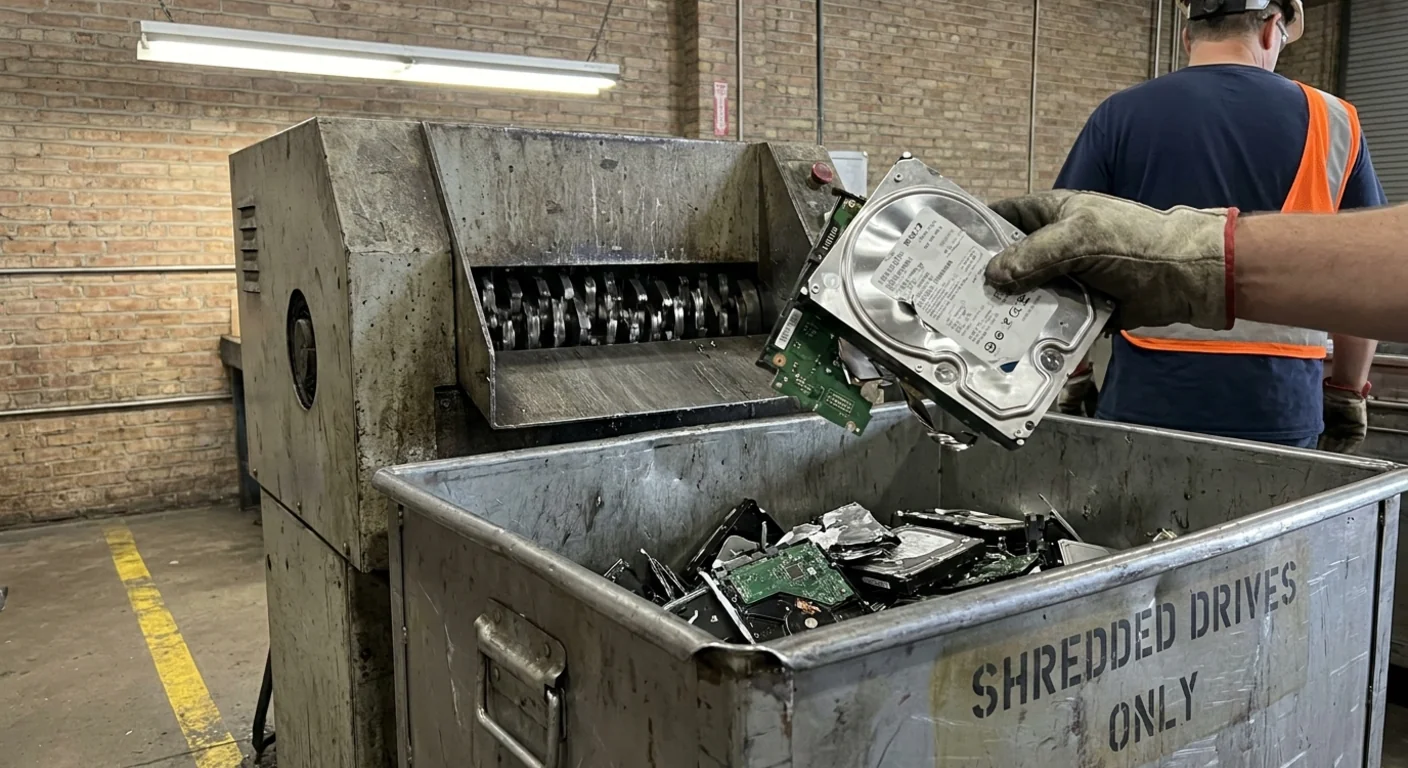
Financial institutions in Chicago handle some of the most sensitive data in the business world, from account numbers and social security information to investment portfolios and loan applications. When storage devices reach end of life, simply deleting files or reformatting drives leaves data vulnerable to recovery by sophisticated threat actors. Physical hard drive destruction provides the highest level of security assurance, rendering data permanently unrecoverable. For banks, credit unions, investment firms, and insurance companies throughout the Chicago metropolitan area, proper destruction protocols are not just best practice but essential to protecting client trust and supporting regulatory compliance requirements.
1. The Limits of Data Wiping for Financial Data
Many organizations initially consider software-based data wiping as a cost-effective solution for decommissioning storage devices. While overwrite methods following DoD 5220.22-M standard or NIST SP 800-88 guidelines can be effective for functional drives, they carry inherent limitations that create unacceptable risk for financial sector data.
Software wiping requires that the drive be fully operational and accessible through normal system interfaces. Damaged drives, drives with bad sectors, or devices with firmware corruption may appear to complete a wipe cycle while leaving recoverable data intact. Additionally, the wiping process provides no physical evidence that data has been destroyed, relying instead on software logs that could be compromised or fabricated.
For financial institutions managing client assets and confidential information, the consequences of a data breach extend far beyond immediate financial loss. Reputational damage, regulatory penalties, and civil liability can threaten an institution's very existence. Physical destruction eliminates these risks by completely destroying the magnetic platters or memory chips where data resides, making recovery impossible regardless of the device's functional state.
Chicago Shredder operates an on-site hard drive crusher at our Addison, Illinois facility, providing verifiable physical destruction that leaves no possibility of data reconstruction. This approach offers financial institutions the certainty they need when disposing of devices containing years of sensitive client records.
2. Understanding Destruction Methods: Shredding, Crushing, and Punching
Physical destruction methods vary in their thoroughness and appropriateness for different security requirements. Understanding these differences helps financial organizations select the right approach for their data protection needs.
Hard drive shredding reduces entire drives to small particles, typically under one inch in size. Industrial shredders process the entire device including the metal casing, circuit boards, and platters, creating output that resembles metallic confetti. This method provides the highest level of physical security and is appropriate for drives containing the most sensitive financial data.
Crushing applies extreme hydraulic pressure to deform the drive and shatter the internal platters. Our on-site crusher at the Addison facility generates sufficient force to ensure that magnetic surfaces are irreparably damaged. The crushing process can be witnessed by clients, providing visual confirmation that drives have been rendered unreadable.
Drive punching forces a hardened steel spike through the drive casing and platters, creating a hole that damages the magnetic surfaces. While faster than shredding, punching may leave portions of the platters intact, making it less suitable for the highest security applications.
For Chicago-area financial institutions, we typically recommend shredding or crushing, as these methods align with the security posture expected in the banking and investment sectors. The choice between methods often depends on volume, timeline, and whether witnessed destruction is required for internal audit purposes.
3. Data Disposal Considerations
Financial institutions operate under multiple regulatory frameworks that impose specific requirements for protecting customer information. The Gramm-Leach-Bliley Act (GLBA) requires financial institutions to protect the security and confidentiality of customer information, including proper disposal of records containing personal financial data. The Fair and Accurate Credit Transactions Act (FACTA) mandates secure disposal of consumer information to prevent identity theft.
While these regulations do not prescribe specific destruction methods, they require that disposal processes render information unreadable or undecipherable. Physical destruction provides the clearest path to demonstrating compliance, as the results are verifiable and irreversible. Chicago Shredder's destruction processes are designed to support compliance requirements across all major financial sector regulations.
Beyond federal law, many financial institutions face contractual obligations to clients, partners, and business associates that require demonstrable data security practices. Insurance companies evaluating cyber liability coverage increasingly scrutinize data disposal procedures, as improper disposal represents a significant source of breach risk.
Documentation of destruction activities provides essential evidence for audits, regulatory examinations, and internal compliance reviews. Our certificate of destruction process creates a permanent record linking specific devices to verified destruction events, supporting the chain of custody requirements that financial auditors expect.
4. Certificate of Destruction and Chain of Custody
For financial institutions, documentation of data destruction is nearly as important as the destruction itself. Regulatory examiners, internal auditors, and compliance officers require verifiable proof that sensitive data has been properly disposed of according to established protocols.
Chicago Shredder provides detailed certificates of destruction that document each destruction event. These certificates include the date of service, the number and types of devices destroyed, the destruction method used, and unique identifiers when available. This documentation creates an auditable trail that connects specific assets to verified destruction activities.
Chain of custody tracking begins when devices are collected from your facility and continues through transportation, processing, and final destruction. Maintaining documented custody at every stage prevents gaps that could raise questions during audits or investigations. For financial institutions with strict internal controls, this unbroken documentation chain demonstrates that devices never left secure custody before destruction.
Many Chicago financial institutions maintain asset inventories that track storage devices throughout their lifecycle. Our certificates integrate with these systems, providing the final disposition record that closes out retired assets. This integration supports IT asset management practices while simultaneously satisfying compliance documentation requirements.
This documentation proves particularly valuable in the event of regulatory examination or legal discovery requests.
5. On-Site Destruction Services for Maximum Security
Some financial institutions with the highest security requirements prefer to witness the destruction of their storage devices rather than releasing them from their direct custody. On-site destruction services address this need by bringing secure destruction equipment to the client's location.
While our primary destruction operations occur at our Addison, Illinois facility, we understand that certain situations warrant on-site service. Branch closures, data center decommissioning projects, and disposal of particularly sensitive devices may require witnessed destruction before devices leave the premises. For these situations, we coordinate mobile destruction services that provide the same security assurance as facility-based processing.
On-site destruction is particularly valuable during merger and acquisition activities, when financial institutions need to quickly and verifiably destroy data related to pending transactions. The ability to witness destruction in real time provides immediate confirmation that confidential deal information will not be exposed through improper disposal.
For most routine destruction needs, however, processing at our secure Addison facility offers significant advantages. Our on-site crusher can handle higher volumes more efficiently, and the controlled facility environment ensures consistent results across all destruction activities. Secure transportation with chain of custody documentation bridges the gap between pickup and processing, maintaining security throughout the entire process.
Whether processing occurs on-site or at our facility, Chicago Shredder maintains the same rigorous security standards that Chicago's financial institutions require. The choice of location depends on your specific operational requirements, security policies, and volume considerations.
6. Why Chicago Financial Institutions Choose Chicago Shredder
Financial organizations throughout the Chicago metropolitan area select Chicago Shredder because we understand the unique pressures facing the sector. Data security cannot be compromised, compliance cannot be questioned, and documentation must be impeccable. Our services are designed around these non-negotiable requirements.
This secure process demonstrates our commitment to sustainable recycling practices and environmental stewardship, values that align with the corporate responsibility initiatives many financial institutions maintain.
Our location in Addison, Illinois provides convenient access for financial institutions throughout Chicago and the surrounding suburbs. We typically respond to service requests within one business day, minimizing the time that decommissioned devices occupy secure storage space in your facility.
The financial sector's data security needs extend beyond hard drives to include servers, backup tapes, mobile devices, and other electronic storage media. Our comprehensive IT asset disposal services address the full spectrum of devices that accumulate sensitive financial data over their operational lifetimes. This unified approach simplifies vendor management while ensuring consistent security standards across all disposal activities.
Many financial institutions work with Chicago Shredder on a recurring basis, establishing scheduled pickup services that integrate seamlessly with IT refresh cycles and equipment retirement schedules. This ongoing relationship ensures that destruction protocols remain consistent and that documentation requirements are understood and met without exception.
7. Environmental Responsibility in Data Destruction
While security drives destruction decisions, responsible environmental stewardship matters to financial institutions committed to corporate sustainability goals. Physical destruction does not mean materials end up in landfills. After drives are rendered unreadable through crushing or shredding, the resulting materials are processed for metal recovery and recycling.
Hard drives contain valuable materials including aluminum, steel, copper, and rare earth elements. These materials can be recovered and returned to manufacturing supply chains, reducing the environmental impact of electronics production.
This combination of security and sustainability addresses both risk management and corporate responsibility objectives. Financial institutions can protect client data while simultaneously advancing their environmental commitments, demonstrating that security and sustainability need not conflict.
For Chicago financial institutions preparing sustainability reports or responding to environmental, social, and governance (ESG) inquiries, our processing practices support positive reporting outcomes. Responsible electronics recycling contributes to waste diversion metrics and demonstrates commitment to resource conservation.
The financial sector increasingly recognizes that stakeholders evaluate institutions on multiple dimensions beyond financial performance alone. Partnering with recycling providers who prioritize both security and environmental responsibility helps institutions meet these broader stakeholder expectations.
8. Frequently Asked Questions
How does physical destruction compare to degaussing for financial data security?
Degaussing uses powerful magnetic fields to disrupt data on magnetic storage media, and can be effective for traditional hard drives. However, degaussing does not work on solid-state drives, which use flash memory rather than magnetic platters. Physical destruction works on all storage device types regardless of technology, making it more versatile and certain for mixed device environments common in financial institutions.
What happens if we need to destroy drives that are still under warranty or lease?
Physical destruction permanently alters devices, making warranty claims or lease returns impossible. Financial institutions should evaluate whether the security benefits of destruction outweigh the potential costs of voided warranties or lease buyout requirements. For devices containing sensitive financial data, the security imperative typically outweighs these financial considerations, but we recommend consulting with your IT asset management team before proceeding.
Can we receive certificates of destruction that include serial numbers for our asset tracking systems?
Yes, our certificates can include device serial numbers and asset tag identifiers when provided. Many financial institutions supply inventory lists that we match against collected devices, ensuring that certificates document the specific assets processed. This level of detail supports precise asset tracking and helps satisfy internal audit requirements for IT asset disposition.
How quickly can you respond to urgent destruction needs during regulatory examinations?
We typically respond to service requests within one business day. For urgent situations such as active regulatory examinations or legal discovery deadlines, we prioritize scheduling to accommodate your timeline. While we cannot guarantee specific service windows, we work closely with financial institutions to address time-sensitive destruction needs whenever possible.
Do your destruction processes align with NIST guidelines for financial sector data?
Our physical destruction processes are designed to support compliance with NIST SP 800-88 guidelines, which recognize physical destruction as the highest assurance method for media sanitization. The guidelines describe destruction methods including disintegration, pulverization, and incineration. Our shredding and crushing processes fall within these categories, producing results designed to be unrecoverable through any known technique.
What happens to backup tapes and other magnetic media we need to destroy?
We process all forms of magnetic storage media including backup tapes, portable drives, and legacy storage formats. The same physical destruction methods that render hard drives unreadable work equally well on tape media. Shredding is particularly effective for tape cartridges, as it destroys both the magnetic tape itself and the protective cartridge housing in a single operation.
Chicago's financial sector handles data that demands the highest levels of protection throughout its entire lifecycle, including final disposition. Physical hard drive destruction provides the security assurance, compliance support, and documentation that financial institutions require. With our on-site crusher at our Addison, Illinois facility and comprehensive chain of custody processes, Chicago Shredder delivers the verifiable destruction that protects client trust and institutional reputation. Whether you manage a community bank, investment firm, insurance company, or credit union, proper data destruction is not optional but essential. Contact Chicago Shredder at 866-770-2650 to discuss your hard drive destruction needs, or schedule a pickup to begin protecting your institution and your clients through secure, documented, and environmentally responsible data destruction.
Ready to schedule a pickup?
Call 866-770-2650 or request a quote online. Every pickup includes clear service documentation.